
London Astrologer
London, UK
- Western astrology
- 20+ years’ experience
- Readings: Online and in person

Astrology techniques
A birth chart reading – also called a natal chart reading – is one of the most common forms of astrology consultation. It explores the whole chart calculated for the moment you were born.
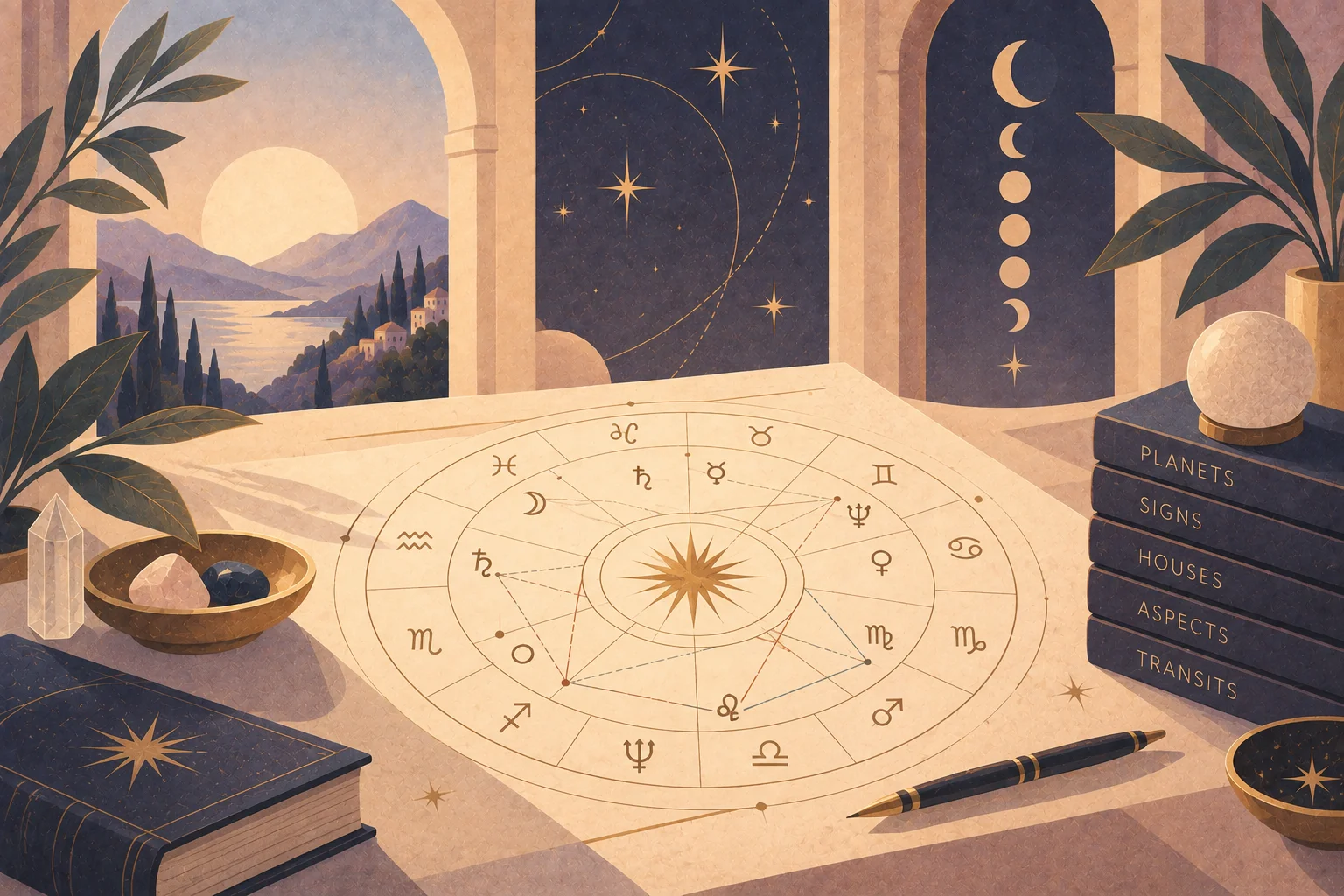
If you are thinking about booking your first astrology reading, there is a good chance that what you are imagining is a birth chart reading.
You give an astrologer your date, time and place of birth. They calculate your chart. Then the two of you spend an hour or so discussing a circular diagram containing enough symbols, lines and mysterious glyphs to make the London Underground map look reassuringly straightforward.
Fortunately, you do not need to understand the diagram yourself.
That is the astrologer’s job.
A birth chart reading, also commonly called a natal chart reading, is an astrology consultation in which an astrologer interprets the positions of the planets, zodiac signs, houses and aspects in your chart at the time of your birth.
Rather than focusing on a single Sun sign or horoscope prediction, the astrologer looks at the chart as a whole.
The aim is usually not to produce a fixed description of who you are or a script for everything that will happen to you.
It is to explore patterns.
Those patterns might concern your personality, relationships, work, emotional life, strengths, conflicts, motivations, values or sense of direction.
Yes.
Birth chart reading and natal chart reading are generally two names for the same thing.
The word natal simply means relating to birth.
You may therefore see astrologers describe their service as:
The terminology varies, but the basic idea is the same: the astrologer interprets the astrological chart calculated for the time and place of your birth.
This type of work belongs to the branch of astrology known as natal astrology.
You can read our guide to natal astrology and birth chart readings if you want to explore the subject in more depth.
A birth chart is a symbolic representation of the sky at a particular moment and place.
For a natal chart, that moment is your birth.
The chart records the positions of the Sun, Moon and planets in relation to the zodiac, together with other astrological information such as houses and aspects.
Different astrological traditions may calculate or interpret charts somewhat differently, but most natal astrologers are trying to understand how several parts of the chart work together.
A birth chart is therefore much more than your Sun sign.
Your Sun may be in Leo, for example, but your Moon might be in Pisces, your Ascendant in Capricorn and several planets clustered somewhere else entirely.
Astrology has rarely been accused of lacking detail.
A professional astrologer will normally consider several layers of the chart rather than interpreting one placement in isolation.
These may include:
In astrology, the planets represent different symbolic functions or themes.
For example, an astrologer might associate:
Outer planets may also be considered, depending on the astrologer’s tradition and approach.
The sign occupied by a planet describes something about how that planetary symbolism may be expressed.
This is why knowing someone’s Sun sign tells you only a small part of the story.
The houses divide the chart into areas traditionally associated with different parts of life.
Depending on the chart and the astrologer’s method, these may include themes such as:
Aspects describe geometrical relationships between planets.
Astrologers interpret these relationships as showing how different parts of the chart interact.
Some combinations may feel relatively easy to express.
Others may suggest tension, contradiction or a need to reconcile competing impulses.
Most human beings contain a few contradictions, so astrology is on fairly safe ground there.
A birth chart reading can be used to explore many different questions.
You might talk about:
The exact emphasis depends partly on what you want from the consultation.
Some people arrive with a very specific question.
Others simply want to understand themselves better.
If this is the part you are most curious about, our separate guide explains in more detail what a birth chart reading can tell you.
There is no single format followed by every astrologer.
Some readings are highly structured.
Others are more conversational.
Before the appointment, the astrologer will normally calculate your natal chart from the birth information you provide.
They may also spend time studying the chart before speaking with you.
During the reading, they might begin by explaining the main patterns they notice.
You may discuss particular planets, houses or aspects, but a thoughtful astrologer should help you understand how those pieces connect rather than simply delivering a catalogue of placements.
Ideally, the reading becomes a conversation.
You can ask questions.
You can say when something does not resonate.
You can tell the astrologer which areas of your life feel particularly relevant.
You are not sitting an exam in your own personality.
Our guide to what happens during an astrology reading takes you through the consultation process in more detail.
An astrologer will normally ask for three pieces of information:
This establishes the planetary positions for the day you were born.
Location is needed to calculate important parts of the chart, including the houses.
An accurate birth time helps determine the Ascendant and house positions.
Birth certificates or official records are often the best place to start if you are unsure.
But not knowing your exact birth time does not necessarily mean you cannot have a useful reading.
Some parts of the chart can still be interpreted, and some astrologers are experienced in working with uncertain birth times.
Read what if I don’t know my birth time? for a fuller explanation.
Not necessarily.
A birth chart itself describes the astrological pattern associated with your birth rather than the planetary movements happening now.
Some astrologers may use the natal chart alongside timing techniques such as:
Those techniques can be used to explore particular periods of life.
But astrologers also differ considerably in how they understand prediction.
A psychological astrologer may focus primarily on self-understanding and development.
A divinatory or traditional astrologer may place greater emphasis on events, circumstances or timing.
Others combine several approaches.
This is one reason it is useful to understand the difference between an astrologer’s branch, tradition, approach and techniques. Our guide to astrology traditions, branches, approaches and techniques explains those distinctions.
No.
Two astrologers can look at the same natal chart and offer noticeably different readings.
That does not necessarily mean one of them is wrong.
Astrologers differ in:
A psychological astrologer may focus heavily on emotional patterns and self-understanding.
A Hellenistic astrologer may place greater emphasis on traditional planetary rulerships, houses and timing methods.
An evolutionary astrologer may interpret the chart through themes of development, purpose and transformation.
A Jyotish practitioner may work within a substantially different astrological framework.
The chart may be the same starting point.
The conversation can be very different.
A horoscope usually offers a short interpretation based on a limited piece of astrological information, often your Sun sign.
A birth chart reading is personalized.
It is based on your specific birth details and considers the relationship between many different parts of the chart.
That is why someone born under the same Sun sign as you may have a very different natal chart.
Your Sun sign is one sentence.
Your birth chart is closer to the entire novel – including a few chapters you may have been pretending not to notice.
A first natal chart consultation often lasts somewhere around an hour, although practitioners vary considerably.
Some offer shorter introductory readings.
Others work for 75 or 90 minutes, particularly when covering the entire natal chart.
A longer session is not automatically better.
What matters is whether the astrologer gives you enough space to understand the interpretation, ask questions and explore the areas that matter to you.
Yes.
Birth chart readings work particularly well online because the astrologer can calculate and study your chart before the consultation and then discuss it with you by video or telephone.
Many practitioners also share the chart on screen during the session.
An online consultation can therefore work much like an in-person reading.
Our guide to online astrology readings explains what to expect.
You do not need to learn astrology beforehand.
You are paying the astrologer partly so that you do not have to spend the previous weekend memorizing planetary glyphs.
It can, however, help to think about what you would most like to explore.
Before the reading:
You can also read our full guide to preparing for an astrology reading.
Because natal chart readings are so common, many astrologers offer them.
That makes the way the astrologer works especially important.
Look beyond the words birth chart reading on the services page.
Consider:
Someone looking for a reflective conversation about relationships and emotional patterns may want a very different astrologer from someone seeking traditional timing analysis.
There is no universally correct choice.
The goal is to find someone whose expertise and way of working fit what you are looking for.
Our guide to choosing the right astrologer explains what to compare before booking.
Astrology has always existed in conversation with questions about fate and choice.
That tension is hardly unique to astrology.
The Greeks had the Moirai – the Fates – spinning and cutting the thread of human life. Modern people have calendar notifications, mortgage rates and family WhatsApp groups.
We have not entirely escaped forces beyond our control.
A responsible birth chart reading should nevertheless leave room for agency.
An astrologer may describe tendencies, patterns, tensions or periods that appear significant within their system of astrology.
That is different from telling you that one outcome is inevitable.
A chart can be approached as a symbolic framework for understanding experience without treating your life as something already written.
That depends on what you want from it.
A birth chart reading may be valuable if you are curious about:
It is less likely to satisfy you if you want absolute certainty or someone else to make your decisions for you.
The best readings tend to generate better questions as well as answers.
Sometimes the useful moment is not hearing something completely new.
It is hearing something familiar described from an angle you had never considered before.
A birth chart reading is also commonly called a natal chart reading, natal astrology reading or natal chart interpretation.
Yes. Natal chart and birth chart generally refer to the same astrological chart calculated for the date, time and place of a person’s birth.
An accurate time is preferable because it affects the Ascendant and houses, but some astrologers can still provide a useful reading without an exact birth time.
It may include interpretation of the planets, zodiac signs, houses, aspects and major patterns in the chart. The astrologer may explore areas such as personality, relationships, work, emotional life, strengths and life direction.
It can be, but it does not have to be. Some astrologers focus primarily on the natal chart itself, while others combine it with predictive or timing techniques such as transits or progressions.
There is no required frequency. Many people begin with one comprehensive natal reading and return to astrology later when they have new questions or are experiencing an important period of change.
Yes. Astrologers may use different traditions, techniques and approaches, so interpretations can vary even when they are working from the same chart.
For many people, a birth chart reading is their first serious encounter with astrology.
It moves the conversation beyond the question “What’s your star sign?” and towards something much more individual.
Your natal chart contains many symbols and relationships.
A good astrologer helps you make sense of them without pretending that a diagram can reduce an entire human life to a handful of neat conclusions.
That is perhaps the most useful way to think about a birth chart reading.
Not as a verdict.
Not as an instruction manual.
As a conversation with a map.
Find a good astrologer
Compare professional astrologers by their experience, approach, traditions and consultation options.
London, UK

Toronto, Canada

Sydney, Australia

Seattle, United States
San Francisco, United States

New York, USA