
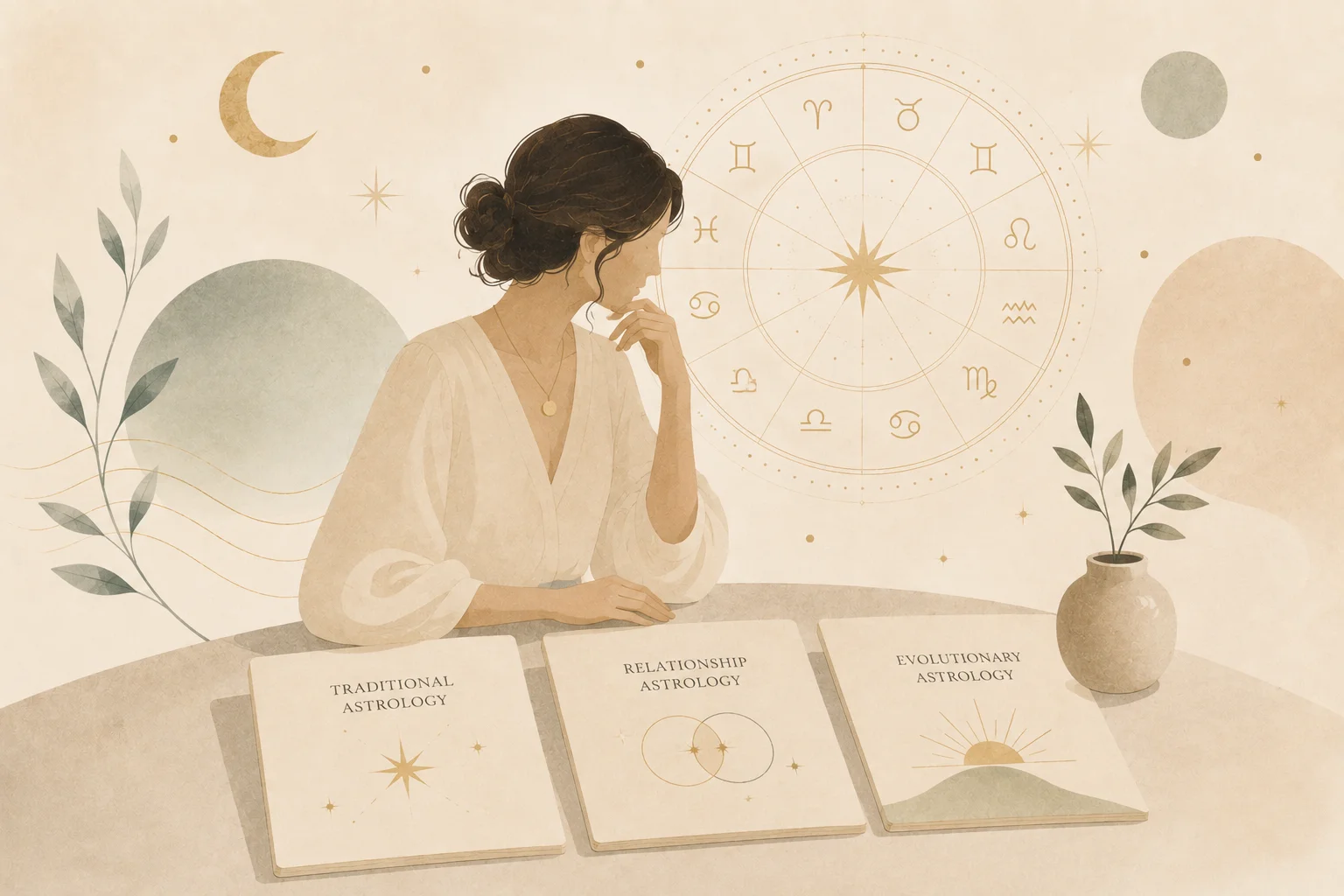
There are moments in life when Google simply isn’t enough.
It can tell you who has a booking slot on Thursday. It is rather less accomplished at telling you who you want discussing the parts of your life you haven’t quite said out loud.
Perhaps you’re standing at a crossroads in your career. The ancient Greeks associated crossroads with Hecate – places of uncertainty, possibility and more than one road forward. Some human dilemmas have evidently been around for a while. Perhaps you’ve come through the end of a relationship that seemed to unravel overnight. Perhaps life is going well on paper, yet something quietly insists there’s another chapter waiting to be written. Or perhaps you’re simply curious. Curious about yourself. Curious about why certain patterns seem to repeat. Curious about whether astrology might offer a different way of understanding your life.
If you’ve found yourself searching for a good astrologer, you’re not alone.
Thousands of people have their first astrology reading every year. Many arrive with the same questions. Will they tell me my future? What if I don’t believe everything they say? What if I don’t know my birth time? How do I know if the astrologer is any good?
They’re sensible questions.
Finding the right astrologer isn’t just about choosing someone with an impressive website or a long waiting list. Neither a beautifully lit photograph nor a six-month wait is, by itself, evidence of wisdom. It’s about finding someone whose experience, approach and personality are a good fit for you. Like any profession built around conversation and trust, the relationship matters almost as much as the expertise.
And perhaps that’s the first thing worth knowing.
A good astrologer isn’t there to tell you how to live your life. They’re there to help you understand it a little more clearly.
Why people really seek an astrology reading
Very few people wake up one morning thinking, I’d quite like someone to interpret my birth chart today.
Most people come to astrology because life has asked a difficult question.
They may be wondering whether to change careers. Whether a relationship has reached its natural end. Why the same arguments keep appearing in different relationships. Why success hasn’t brought the fulfilment they expected. Or why they feel restless when, by every outward measure, everything should be fine.
Astrology doesn’t remove uncertainty from life. Nor should it.
But many people find that it offers something just as valuable – perspective.
Rather than seeing life as a collection of disconnected events, astrology invites us to consider whether our experiences form part of larger patterns. Whether recurring themes might have something to teach us. Whether difficult seasons are simply obstacles, or invitations to grow.
Carl Jung wrote extensively about symbols, archetypes and the unconscious. Whether or not you agree with every aspect of his work, his central insight feels surprisingly relevant to astrology: sometimes we understand ourselves more deeply through stories and symbols than through facts alone.
Perhaps that’s one reason astrology has endured for thousands of years.
What does a good astrologer actually do?
Many people imagine an astrologer making dramatic predictions.
In reality, most professional astrologers work rather differently.
A birth chart is a symbolic map based on the date, time and place of your birth. Rather than predicting every detail of your future, many astrologers use it to explore your personality, strengths, recurring patterns, challenges and the themes that seem to run through your life.
A reading is usually a conversation.
Your astrologer may explain different parts of your chart, ask questions, encourage reflection and help you explore whatever brought you there in the first place.
What can an astrologer help with?
Depending on their experience and approach, an astrologer may help you explore relationships, career direction, life purpose, personal strengths, recurring emotional patterns, major life transitions, confidence, family dynamics, timing and significant life periods. If you’re new to astrology, our guide to different types of astrology explains some of the traditions, approaches and techniques you may encounter.
Notice the word explore.
Good astrologers don’t replace your judgement. They help you develop it.
What makes a good astrologer?
A good astrologer should make you feel listened to rather than lectured.
They should explain ideas clearly without trying to impress you with technical language.
They should respect your free will.
They should leave you feeling more empowered than dependent.
Athena is a more useful archetype here than an all-knowing oracle: intelligence, perspective and better judgement rather than instructions handed down from above.
Our guide to what defines a good astrologer explains the standards, ethics and professional qualities we believe matter across different traditions and approaches.
Before you book, it can also help to think about what questions you want to ask an astrologer.
Experience, qualifications and approach
Consider experience, training, professional memberships, reviews and areas of expertise. An astrologer with decades of experience isn’t automatically the right person for every client. Connection matters too.
Do I need my birth time?
Ideally, yes.
But if you don’t know it, don’t panic. Family memories of birth times have a curious tendency to become more precise with every retelling. Many astrologers can still provide a valuable reading using your birth date and place. Read our guide to what to do if you don’t know your birth time for more detail, and simply ask before booking.
Online or in person?
Today, many experienced astrologers work online. Our guide to online astrology readings explains what to expect from a remote consultation. Often, the right astrologer is the one whose approach fits you best, regardless of where they live.
Red flags
Be cautious if someone guarantees specific future events, discourages independent thinking or encourages fear and dependency.
Good astrology creates understanding.
It shouldn’t create dependency.
What does a good astrology reading feel like?
A good reading rarely feels like someone telling you who you are.
It feels more like someone gently holding up a mirror.
The best readings help you recognize yourself, ask better questions and see familiar patterns in a new light. If you’re wondering what the experience itself is like, read our guide to what happens during an astrology reading.
Is astrology about predicting the future?
Many modern astrologers prefer to discuss possibilities rather than certainties.
A birth chart isn’t a prison sentence.
Perhaps it’s closer to a map.
More than answers
Many people leave a reading not with certainty, but with clarity.
Astrology doesn’t absolve us of responsibility.
If anything, it gently increases it.
Because once we become aware of a pattern, we gain the opportunity to respond differently.
Choosing the astrologer who feels right
There isn’t one perfect astrologer.
There is only the astrologer who feels right for you at this point in your life.
The best astrologer for you isn’t trying to convince you they’re extraordinary.
They’re trying to help you discover something extraordinary about yourself.
Perhaps that’s the real purpose of an astrology reading.
Not to tell you who you are.
But to begin a conversation with the person you’ve been becoming all along.
Before you book – your astrology reading checklist
- Think about why you’re booking. What would you most like to explore?
- Find your date, time and place of birth. If you don’t know your birth time, ask whether it’s essential.
- Read the astrologer’s profile. Look at their approach, traditions, experience and training.
- Look at their approach and experience. Consider the traditions and techniques they use, their experience and the kinds of questions they are comfortable exploring.
- Look for experience, training and reviews. It’s also worth understanding how much an astrology reading costs so you can compare fees and decide what represents good value for you.
- Decide whether you prefer online or in person.
- Prepare two or three questions in advance.
- Keep an open mind. The best readings are conversations.
- Don’t expect certainty. Good astrologers explore possibilities rather than make guarantees.
- Choose someone you trust, not someone who promises miracles.
- Bring something to take notes with, or ask if the session can be recorded.
- Give yourself time afterwards to reflect.
Want something simpler to keep beside you while you compare astrologers? Use our astrology reading checklist.
Perhaps the most important thing…
You don’t need to understand astrology before your first reading.
Your job is simply to arrive with curiosity, honesty and a willingness to explore.
Everything else can unfold from there.