
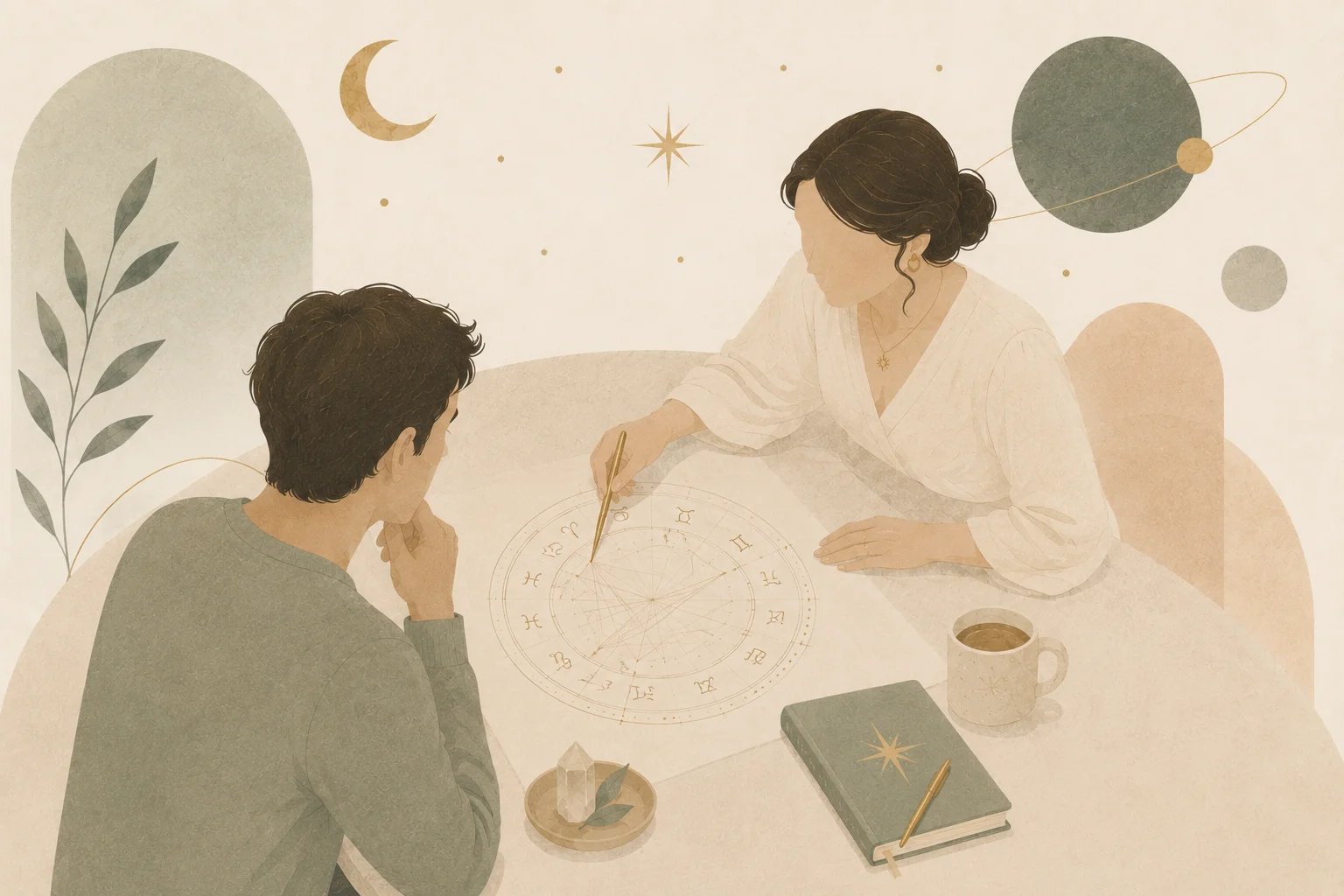
There are few experiences quite like booking your first astrology reading.
You may have imagined doing it for years before finally taking the plunge. Or perhaps you’ve found yourself at a crossroads – a relationship ending, a career changing, a growing sense that life is nudging you in a new direction. Someone recommends astrology. You become curious. Before long you’re wondering what on earth actually happens once the Zoom call starts or you walk through the astrologer’s front door.
It’s a fair question.
If you’ve never had an astrology reading before, it’s easy to imagine something rather mysterious. Will they predict your future? Will they spend an hour talking about planets you don’t understand? Will they ask lots of personal questions? What if you cry? What if nothing they say makes any sense?
The reality is usually much simpler.
A good astrology reading isn’t a performance.
It’s a conversation.
And like any worthwhile conversation, it begins with curiosity.
Janus, the Roman god of doorways and transitions, was depicted looking both backwards and forwards. That’s not a bad image for a first reading: understanding where you’ve come from while becoming more curious about what might come next.
Why people book an astrology reading
Very few people book an astrology reading simply because they’re interested in astrology.
They’re interested in their own lives.
Perhaps they’re trying to understand why certain relationships follow familiar patterns. Perhaps they’re considering a career change but can’t quite explain why they feel restless. Some people arrive after becoming parents. Others after a bereavement, divorce or redundancy. Some simply reach a point where they feel they’ve become strangers to themselves.
Whatever brings someone to astrology, they’re usually looking for perspective rather than prediction.
That’s an important distinction.
A thoughtful astrologer isn’t trying to convince you that the future is already written. They’re trying to help you understand the landscape you’re walking through so that you can make wiser, more conscious choices.
In many ways, that’s why astrology has remained relevant for thousands of years.
Not because it removes uncertainty.
Because it helps us navigate it.
Before the reading begins
Once you’ve booked your appointment, your astrologer will usually ask for three pieces of information:
- your date of birth
- your place of birth
- your time of birth
These details allow them to calculate your birth chart – a symbolic map of the sky at the moment you were born.
If you’ve read our guide on choosing the right astrologer, you’ll already know that an accurate birth time helps produce a more detailed chart, particularly when calculating your Rising sign and the houses. But don’t worry if you don’t know it. Many astrologers can still offer a meaningful consultation, and they’ll explain any limitations before the reading begins.
Some practitioners may also ask whether there’s anything in particular you’d like to discuss. If you’re unsure how to prepare, our guide to preparing for an astrology reading covers the practical things worth thinking about beforehand.
That’s not because they’re preparing a script.
It’s because they want the reading to be genuinely useful.
You are allowed, incidentally, to arrive without having turned your life into a beautifully organized five-year plan. Most of us have not.
So… what actually happens?
For most people, the biggest surprise is how normal it feels.
There are no secret rituals.
No mysterious incantations.
No expectation that you already understand astrology.
There is no celestial entrance exam.
Your astrologer will usually begin by explaining your birth chart in straightforward language. They’ll introduce the major themes, describe some of the patterns they see and invite you to respond along the way.
That’s important.
A good reading isn’t a lecture.
It’s a dialogue.
You might hear observations that instantly resonate. Others may make sense only after you’ve had time to reflect. Occasionally you’ll disagree with something. That’s perfectly healthy. Astrology is at its best when it opens a conversation rather than closes one.
In fact, many experienced astrologers would say that the most interesting moments happen when a client says, “I’ve never thought about myself like that before.”
Those moments aren’t about proving astrology right.
They’re about helping someone see themselves from a different perspective.
Perhaps that’s why so many people describe a good reading as both deeply personal and strangely reassuring.
Not because every question has been answered.
But because life suddenly seems to make a little more sense.
What does the astrologer actually look at?
The answer depends on the astrologer’s tradition and approach.
Some astrologers work primarily with the natal chart – the map of the sky at your birth. Others combine it with techniques that look at planetary movements and cycles unfolding later in life. Some place greater emphasis on psychological interpretation, while others work within traditional or predictive traditions.
There isn’t one universal method.
That can sound confusing when you’re new to astrology, but it’s actually one of the things worth discovering before you book. Our guide to different types of astrology explains the main traditions, approaches and techniques you may encounter.
A typical natal reading might explore the positions of the Sun, Moon and planets, the twelve houses of the chart and the relationships between different planets, known as aspects.
Don’t worry if that sounds like another language.
You aren’t expected to arrive knowing what a conjunction is, or why Saturn might be important in your chart. That’s what you’re paying the astrologer to explain.
The important thing is whether they can make the symbolism meaningful to you.
Will the astrologer ask me questions?
Usually, yes.
And that’s a good thing.
A professional reading isn’t supposed to be a mind-reading competition in which the astrologer tries to guess your life while you sit silently and wonder whether they’ve got it right.
Your astrologer may ask about your experiences, relationships, work or the reason you’ve come for a consultation. They may check whether something they’re seeing in the chart resonates with your experience.
You can also ask questions. If you’re not sure what to ask, our guide to questions to ask an astrologer can help you prepare.
In fact, you should.
If there’s something you’ve been thinking about for months, bring it into the conversation. If a particular relationship is troubling you, say so. If you’re wondering about a career decision, ask whether the astrologer can explore that area of your chart.
You don’t need to have the perfect question, either.
Sometimes you arrive knowing exactly what you want to ask. Sometimes you simply know that something feels unsettled.
That’s enough.
A good astrologer can help you discover what the question actually is.
What if I don’t understand the astrology?
You don’t need to.
This is one of the most common worries among first-time clients, particularly if they’ve looked at a birth chart online and encountered a bewildering collection of planets, houses, signs and symbols.
It can look rather like someone has emptied a box of astronomical Scrabble tiles onto a page.
Your astrologer should translate it.
Technical knowledge is important, but communication matters too. A practitioner may know an extraordinary amount about astrology, but if they can’t explain what they’re seeing in language you can understand, the knowledge isn’t much use to you.
Don’t be afraid to ask:
“What does that mean in everyday life?”
Or:
“Can you explain that without the astrology jargon?”
You aren’t failing the reading.
You’re doing exactly what you’re supposed to do.
Will they tell me what is going to happen?
This is where astrology becomes particularly interesting.
Some astrological traditions place considerable emphasis on prediction. Others focus more on psychological insight, symbolism and personal development. Many astrologers combine several approaches.
So there isn’t one answer.
A responsible astrologer should be able to explain what they mean when they talk about the future.
Cassandra was cursed to foresee what was coming with terrible certainty. A good astrology consultation should feel rather less fatalistic: possibility, context and choice matter.
A transit, for example, may be described as a period associated with pressure, growth, change or opportunity. That doesn’t necessarily mean that one specific event is guaranteed to happen on one specific Tuesday.
Human beings aren’t machines.
We make choices. Circumstances change. We surprise ourselves.
This is where astrology can become less about fortune-telling and more about self-development.
A difficult period might reveal a pattern you’ve been avoiding. A major transition might force you to reconsider an old idea of who you are. A relationship might expose a part of yourself that you’ve never really understood.
The chart may provide the symbolism.
What you do with it is still yours.
Can I disagree with the astrologer?
Absolutely.
Perhaps this is worth saying more often.
You are allowed to hear an interpretation and think, Nope. Not me.
You don’t have to accept every statement simply because someone has interpreted your chart.
Paying for the hour does not require you to surrender your critical faculties along with your coat.
A thoughtful astrologer should be interested in your response. Sometimes your disagreement may reveal that a particular interpretation isn’t relevant. Sometimes it may open a more interesting conversation about why it doesn’t resonate.
Astrology is not a test you can fail.
And the astrologer isn’t your headteacher.
The relationship between practitioner and client works best when there is room for curiosity, conversation and even the occasional raised eyebrow.
Is an astrology reading like therapy?
There can be similarities.
Both can involve reflection, difficult questions and a deeper exploration of patterns in your life. A psychologically informed astrologer may also draw on ideas about archetypes, projection, the shadow and personal development.
But an astrology reading isn’t psychotherapy, and an astrologer shouldn’t present it as a substitute for appropriate medical or mental health care.
The distinction matters.
Astrology can offer a symbolic framework for reflection. Therapy has its own professional training, methods and responsibilities.
One doesn’t need to diminish the other.
Sometimes people find that a reading gives them language for something they’ve been feeling but couldn’t quite articulate. That’s potentially valuable in its own right.
What if something in the reading makes me emotional?
It might.
You’re talking about your life, after all.
A birth chart can sometimes provide a surprisingly direct way of discussing experiences that are difficult to put into ordinary conversation. You might recognize an old pattern. You might suddenly understand why a particular period affected you so deeply. You might simply feel seen.
You don’t have to apologise for that.
Equally, you don’t have to have a profound emotional experience for the reading to be worthwhile.
Sometimes the most useful observation is a small one that stays quietly in the back of your mind.
That’s often how insight works.
It doesn’t always arrive with dramatic music.
What can you actually get out of a reading?
This is perhaps the most interesting question of all.
The answer will be different for everyone.
You might leave with:
- a clearer understanding of your personality
- language for recurring patterns
- a new perspective on a relationship
- greater awareness of your strengths
- questions about what you want next
- reassurance during a difficult period
- a sense of possibility
- or simply the feeling that someone has helped you look at your life from a different angle
The value isn’t necessarily in being told something you didn’t know.
Sometimes it’s in hearing something you already knew, but finally seeing it in a different context.
And perhaps that’s where the more spiritual dimension of astrology enters the picture.
Many traditions have understood human life as a journey of development – a movement through different stages, challenges and opportunities to become more fully ourselves. Ideas such as karma, archetypes and synchronicity offer different ways of asking whether our experiences might carry meaning beyond the immediate circumstances.
You don’t have to hold one particular belief about that.
But it’s an interesting question.
What if some of the patterns we encounter in life are not simply problems to solve, but invitations to understand ourselves more deeply?
That is one of the reasons an astrology reading can stay with you long after the appointment has ended.
What does a good astrology reading feel like?
This is perhaps the part that’s hardest to explain.
You can describe the birth chart. You can explain the planets and houses. You can talk about transits and aspects until the cows come home.
But what does it actually feel like to sit with another person and talk about your life through the language of astrology?
For many people, it feels surprisingly ordinary at first.
You talk.
You listen.
You ask questions.
And then, occasionally, something lands.
A sentence catches you slightly off guard because it describes something you’ve felt for years but never quite managed to put into words. A pattern suddenly becomes visible. A difficult period begins to look different. Or you find yourself wondering about a part of your personality you’d previously taken for granted.
That doesn’t mean every sentence will feel profound.
It shouldn’t.
A good reading isn’t a performance in which the astrologer produces a series of dramatic revelations while you sit there waiting to be impressed. Sometimes the most valuable insight is remarkably simple.
“I’ve always done that.”
“That’s exactly what happens in my relationships.”
“I never thought about it that way.”
Those little moments can be the beginning of something.
What if nothing resonates?
This is worth discussing because not every interpretation will feel immediately relevant.
You might hear something and think, No. That’s not me at all.
That’s okay.
Your birth chart isn’t a personality questionnaire with a score at the end. Astrology is interpretive, and different astrologers may emphasise different symbols or patterns.
Give yourself permission to be discerning.
You don’t have to force a connection simply because you paid for the reading. Nor should an astrologer try to persuade you that you’re secretly exactly as they’ve described.
Sometimes an interpretation needs more context. Sometimes it simply isn’t useful.
A thoughtful astrologer can live with that.
What happens after the reading?
You might receive a recording, notes, a copy of your birth chart or other resources, depending on the astrologer.
But the more interesting part is what happens internally.
Some insights arrive immediately. Others take time.
You might find yourself thinking about the reading later that evening. Then again while making coffee the next morning. Perhaps something comes back to you weeks later when a situation unfolds that suddenly makes the astrologer’s observation seem relevant.
This is one reason not to judge a reading solely by how many revelations you have during the appointment.
Some things need time to settle.
The purpose isn’t necessarily to leave with your entire life neatly explained. Frankly, that would be a little suspicious.
A good reading may instead leave you with a handful of useful ideas, a different perspective and a few questions worth living with.
Can an astrology reading change you?
It can be part of a process of change.
But the astrologer doesn’t change you.
You do.
This distinction matters.
Astrology can give you a symbolic language for recognizing patterns. Once you can see a pattern, you have more opportunity to decide what to do with it.
That is where astrology can become a tool for self-development and transformation.
Perhaps you recognize that you repeatedly make yourself smaller to keep relationships peaceful. Perhaps you discover that what you’ve called indecision is actually a fear of disappointing other people. Perhaps a difficult period has forced you to reconsider what success means to you.
The chart doesn’t make the choice.
It may simply help you see the choice more clearly.
Carl Jung’s idea of individuation – the lifelong process of becoming more fully yourself – offers an interesting way of thinking about this. We don’t become ourselves by discovering a perfect personality hidden somewhere inside us. We become ourselves by becoming more conscious of the different parts of who we are, including the parts we’d rather not look at.
Astrology can provide symbols for that exploration.
And perhaps that’s one reason people return to it.
A word about karma
If you are spiritually inclined, you may also find yourself wondering about karma.
Different traditions understand karma in different ways, and Good Astrologers isn’t here to tell you which interpretation you must believe.
But there is something compelling about the idea that our choices have consequences that extend beyond the immediate moment.
Perhaps karma is a literal spiritual principle.
Perhaps it is a metaphor for the patterns we create through our actions.
Perhaps the truth is more mysterious than either explanation.
Astrology doesn’t need to settle the question.
It can simply invite us to ask it.
And if the idea of karma encourages us to take greater responsibility for how we live, treat people and respond to our circumstances, perhaps that’s already a useful place to begin.
How should you feel when you leave?
There isn’t one correct answer.
You might feel excited.
Thoughtful.
Reassured.
A little emotional.
Or simply curious to learn more.
You might even leave with more questions than you arrived with.
That’s not necessarily a problem.
In fact, it may be one of the best outcomes.
The purpose of a good astrology reading isn’t to close down the mystery of your life. It’s to give you another way of looking at it.
And perhaps that is why people describe the experience as strangely reassuring.
Not because someone has finally handed them all the answers.
But because, for an hour or so, the complicated business of being human has been given a language.
Frequently asked questions
Do I need to know anything about astrology before my first reading?
No. You don’t need to know what a house, aspect or transit is. A good astrologer should explain the relevant parts of your chart in language you can understand.
How long does an astrology reading usually last?
There is no standard length. Many consultations last around 45–90 minutes, although some astrologers offer shorter or longer sessions.
Can I ask questions during an astrology reading?
Yes. In most consultations, questions are encouraged. Your own concerns and experiences are part of what makes the reading relevant to you.
What if I don’t know my exact birth time?
Don’t assume you can’t have a reading. Many astrologers can work with an uncertain birth time, although some techniques may not be available or as precise. Ask the astrologer before booking.
Will an astrologer predict my future?
That depends on their approach. Some traditions place more emphasis on prediction and timing, while others focus on psychological insight, symbolism and personal development. A responsible astrologer should be clear about their approach.
Is an astrology reading the same as therapy?
No. There can be similarities in the kind of reflection and conversation involved, but astrology is not psychotherapy and should not be treated as a substitute for appropriate professional healthcare.
What should I expect to get from an astrology reading?
There isn’t one guaranteed outcome. You might gain greater self-understanding, a new perspective on a relationship or situation, reassurance during a difficult period, or simply some useful questions to think about.
Do I need to believe in astrology for a reading to be useful?
Not necessarily. Curiosity is probably more useful than certainty. You can approach a reading with an open mind while still thinking critically about what you hear.
A little more curious than when you arrived
Perhaps the best first astrology reading doesn’t tell you exactly what is going to happen next.
Perhaps it does something more interesting.
It gives you a different way of looking at what has already happened, what is happening now and what might be possible from here.
The astrologer provides the symbols.
The conversation provides the context.
And you decide what to do with what you discover.
Life is complicated. People are complicated. Our relationships with ourselves and each other can be wonderfully, maddeningly messy.
Astrology won’t tidy all of that up.
But it may give you a new language for making sense of it.
And sometimes, that’s a very good place to start.
Before you book – preparing for your first astrology reading
If you’re thinking about booking your first reading, you don’t need to become an astrology expert first. A little preparation is enough.
- Find your birth details. Have your date, place and, if possible, exact time of birth ready.
- Don’t panic if you don’t know your birth time. Read our guide to what to do if you don’t know your birth time and ask the astrologer whether they can work without it.
- Think about what brought you here. Is there a particular question, relationship, decision or period of change you’d like to explore?
- Prepare a few questions. You don’t need a script. Two or three things you’re genuinely curious about are plenty.
- Read the astrologer’s profile. Look at their approach, traditions, experience and training.
- Ask what kind of reading they offer. Different astrologers use different traditions and techniques.
- Ask practical questions before booking. Find out how long the reading lasts, whether it is online or in person, whether you’ll receive a recording or notes, and how much the reading costs.
- Be honest during the reading. You don’t need to tell your astrologer everything, but useful context can make the conversation more meaningful.
- Ask for clarification. If something doesn’t make sense, say so.
- Remember that you remain in charge. You don’t have to accept every interpretation or prediction.
- Give yourself some space afterwards. Let the reading settle before deciding exactly what it meant to you.
- Stay curious. You may not leave with all the answers. You may leave with better questions.
If you’re still choosing who to book with, use our astrology reading checklist to compare practitioners.
Perhaps the most important thing…
You don’t need to understand astrology before your first reading.
Your job is simply to arrive with curiosity, honesty and a willingness to explore.
Everything else can unfold from there.