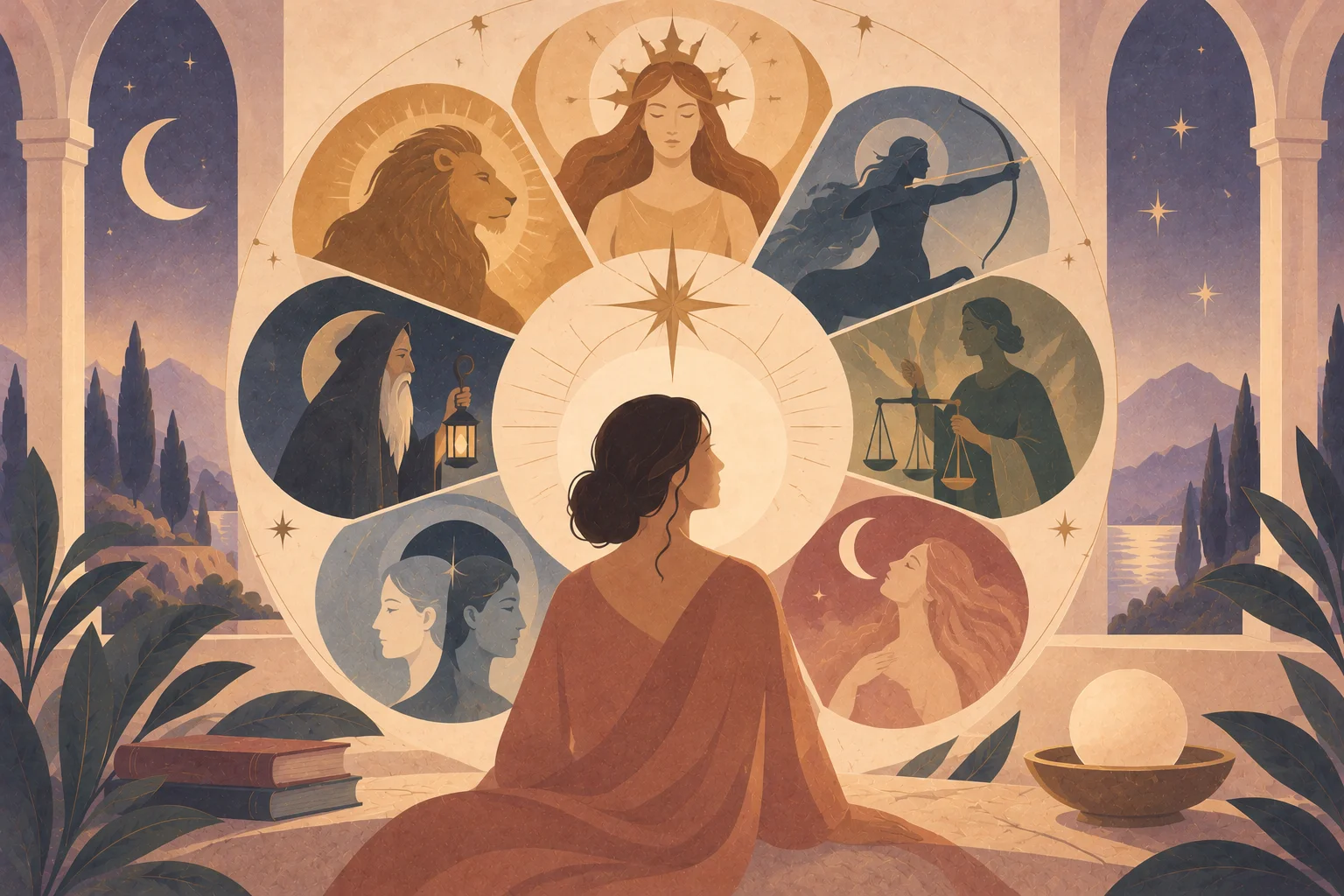
A birth chart contains a rather improbable cast.
Venus wants something.
Mars wants something else.
Saturn has concerns.
Pluto has arrived without explaining how long he intends to stay.
Archetypal astrology begins with the idea that these planetary symbols describe recurring patterns of human experience rather than one-dimensional traits or fixed events.
A planet is not simply a keyword.
It is closer to a character, force or theme with many possible expressions.
Mars can appear as courage, anger, competition, sexuality, conflict or the decision that today is finally the day you send the email.
Saturn can describe restriction, discipline, fear, responsibility, authority or the slow construction of something durable.
Venus may speak through pleasure, attraction, beauty, relationship, compromise and the things we decide are worth wanting.
Archetypal astrology explores these larger symbolic patterns and asks how they are appearing in a particular life.
That makes it especially appealing to people who are interested in psychology, mythology, stories and the strange fact that human beings have been wrestling with remarkably similar themes for thousands of years.
What is archetypal astrology?
Archetypal astrology is an approach that understands astrological symbols as expressions of archetypes.
An archetype is a recurring pattern or organizing image that can appear in many different forms.
Think about the archetype of the warrior.
It might appear as:
- physical courage
- competition
- anger
- defending somebody
- ambition
- sexual pursuit
- conflict
- decisive action
No single example exhausts the archetype.
That flexibility is central to archetypal astrology.
If Mars is prominent in a chart, an archetypal astrologer is unlikely to conclude simply that you are “aggressive”.
They may instead explore your relationship with assertion, desire, conflict, courage and action.
Perhaps Mars is something you express easily.
Perhaps you encounter it primarily through other people.
Perhaps you avoid conflict until six months of accumulated irritation suddenly produces an email with numbered paragraphs.
The symbol remains recognizable.
Its expression is personal.
What does ‘archetypal’ mean?
The word archetype has a long intellectual history, but it became particularly influential in modern psychology through the work of Carl Jung.
Jung used the term to describe deep recurring patterns that appear in dreams, myths, religion, stories and human imagination.
Figures such as the mother, hero, trickster, shadow or wise old person recur across different cultures and periods, even though the stories surrounding them differ.
Modern astrologers found an obvious connection.
The planets had already accumulated centuries of symbolic associations.
Mars with war and assertion.
Venus with attraction and relationship.
Saturn with time, limitation and authority.
Mercury with language, movement, trade and trickery.
Archetypal astrology approaches these not as rigid definitions but as families of meaning.
The chart becomes a way of exploring which symbolic patterns are particularly prominent and how they interact.
Are planets the same as mythological gods?
No.
The connection is symbolic, not literal.
Western planetary names carry associations with Greco-Roman gods, and their myths can provide extraordinarily rich ways of thinking about planetary themes.
But an archetypal astrologer does not need to believe that the planet Venus is literally the goddess Aphrodite influencing your dating life from space.
Myth supplies images.
Astrology supplies a symbolic structure.
Your life supplies the rather less tidy material.
Take Hermes, the Greek messenger god associated with movement, language, boundaries, commerce, cleverness and occasional mischief.
Those themes overlap strikingly with the astrological symbolism of Mercury.
Hermes can therefore help us imagine Mercury as something much richer than “communication”.
Mercury may describe how we think, negotiate, translate, travel between different worlds of experience and occasionally talk ourselves into situations that could have been avoided by saying nothing.
The myth expands the symbol.
It does not prove it.
Why use mythology in astrology?
Because myths are very good at holding contradictions.
A mythological figure is rarely reducible to one admirable quality and a tasteful LinkedIn bio.
The gods are contradictory.
They love, betray, create, destroy, rescue, deceive and occasionally behave in ways that would make a modern HR department extremely nervous.
That complexity makes mythology useful for astrology.
Human beings are contradictory too.
You can want intimacy and independence.
Security and adventure.
Recognition and privacy.
A peaceful life and one specific argument that you absolutely intend to win.
Archetypal astrology gives those tensions symbolic form.
Instead of deciding that one side of the personality is “correct”, the astrologer can explore the relationship between competing patterns.
The birth chart becomes a drama rather than a verdict.
The chart as a cast of characters
One useful way to understand archetypal astrology is to imagine the planets as a cast of characters.
Not literal beings inside you.
More like different organizing tendencies.
Venus wants connection and value.
Mars wants action.
Saturn asks what is sustainable.
Jupiter looks for expansion and possibility.
The Moon needs safety and responsiveness.
These tendencies do not always agree.
That is partly the point.
A chart containing a strong tension between Venus and Saturn, for example, might be explored through themes such as closeness and caution, pleasure and restraint, longing and self-protection.
There is no single predetermined outcome.
The pattern might appear differently at twenty-five, forty-five and seventy.
An archetype develops as our relationship with it develops.
The myth of Athena gives us another useful example.
She embodies intelligence and strategy, but also independence, competition, authority and a distinctly complicated relationship with power.
An archetypal astrologer is interested in precisely that richness.
Symbols become useful when they contain enough complexity to help us think.
Not when they reduce us to a sentence.
What happens in an archetypal astrology reading?
An archetypal astrology reading is usually interpretive and exploratory.
The astrologer may begin with the natal chart and look for recurring symbolic themes across:
- planets
- signs
- houses
- aspects
- current transits or other timing techniques
Rather than treating one placement in isolation, they may ask how several symbols seem to reinforce or complicate one another.
Suppose Mars, Saturn and Pluto are all strongly emphasized.
The astrologer might explore themes involving:
- power
- frustration
- endurance
- control
- anger
- ambition
- authority
- transformation
The question is not simply which keyword applies.
It is how those themes have appeared in your actual life.
You might recognize them in relationships.
In work.
In the way you respond to conflict.
Or in the particular form of self-restraint that looks admirable from the outside and feels exhausting from the inside.
The reading becomes a process of interpretation rather than diagnosis.
Does archetypal astrology predict the future?
It can include forecasting, but prediction is usually not the main purpose of the approach.
Archetypal astrologers may work with transits and planetary cycles to explore periods when particular themes become more prominent.
A Saturn transit might be associated with:
- limitation
- responsibility
- consolidation
- maturity
- endings
- commitment
A Uranus transit might bring themes of disruption, liberation, independence or rapid change.
A Pluto transit may raise questions around power, loss, compulsion or transformation.
But the astrologer is usually less interested in saying exactly which event must happen than in describing the archetypal quality of the period.
That leaves room for different expressions.
Two people experiencing similar planetary cycles may live them in entirely different circumstances.
The symbolism can describe the weather.
It does not necessarily tell you whether you will spend the afternoon walking through it, sheltering from it or discovering that you left the washing outside.
Archetypal astrology and planetary cycles
One of the strengths of archetypal astrology is its ability to connect personal experience with larger planetary cycles.
Some practitioners look not only at natal placements but also at the changing relationships between planets over time.
These cycles can be interpreted as periods when particular archetypal combinations become more noticeable.
For example, a Saturn–Uranus combination might be explored through tensions between:
- stability and disruption
- authority and rebellion
- tradition and innovation
- structure and freedom
The same symbolic combination can appear personally, socially or culturally in many different ways.
This is where archetypal astrology can broaden the conversation beyond:
“What is happening to me?”
towards:
“What kind of pattern am I participating in?”
That shift can be useful when personal experiences seem connected to wider changes around us.
Archetypal astrology vs psychological astrology
Archetypal and psychological astrology are closely related.
Both often treat astrology symbolically.
Both may draw on depth psychology.
Both are generally interested in multiple possible expressions of a planetary placement rather than a fixed one-line meaning.
The difference is mainly one of emphasis.
Psychological astrology tends to focus more directly on the individual psyche:
- emotional patterns
- personality
- relationships
- defences
- inner conflicts
- personal development
Archetypal astrology often places greater emphasis on the symbolic pattern itself.
The astrologer may ask how a larger Saturnian, Venusian or Plutonian theme is expressing itself through your life.
A psychological astrologer might begin with your fear of conflict.
An archetypal astrologer might begin with the Mars symbolism around assertion and confrontation, then explore how you have learned to live that pattern.
In practice, the two approaches overlap considerably.
Many astrologers are both psychological and archetypal in the way they work.
You can compare them more fully in what is psychological astrology? and our overview of different approaches to astrology.
Archetypal astrology vs evolutionary astrology
There is overlap here too.
Both approaches may be interested in meaning, development and patterns that seem larger than everyday personality.
But evolutionary astrology tends to place stronger emphasis on direction and development.
It may ask where a person appears to be coming from and what they are developing towards.
Archetypal astrology is often less linear.
It may be more interested in understanding the recurring symbolic forces themselves and the different ways they can be lived.
An evolutionary astrologer might ask:
“What is this pattern trying to develop?”
An archetypal astrologer may ask:
“What kind of pattern is this, and how is it showing up here?”
Neither question excludes the other.
They simply begin from different places.
Is archetypal astrology spiritual?
It can be, but it does not have to be.
Some archetypal astrologers understand planetary symbolism within a spiritual or metaphysical worldview.
Others approach astrology more as a symbolic language for exploring human experience.
The method itself does not require one particular belief about why astrology works.
That makes archetypal astrology unusually hospitable to mystery.
You can take symbols seriously without pretending you have solved the mechanism behind them.
For some people, that is a feature rather than a problem.
There are already enough people on the internet explaining the universe with complete certainty before you have finished your first coffee.
Who might archetypal astrology suit?
Archetypal astrology may suit you if you are interested in:
- symbolism and mythology
- psychology and the inner life
- recurring patterns in relationships or behaviour
- periods of major change
- exploring meaning without demanding absolute certainty
- understanding a chart as a whole rather than as a list of traits
It may be less suitable if you primarily want a direct answer to a specific practical question.
For that, a more divinatory approach – or a branch such as horary astrology – may feel more appropriate.
The important thing is that the astrologer’s way of working matches the kind of conversation you want.
How to choose an archetypal astrologer
If this approach appeals to you, look at how the astrologer explains their method.
Useful things to consider include:
- how they use mythology and symbolism
- whether their work is also psychological or spiritual
- which traditions and techniques they use
- how much emphasis they place on prediction
- whether they explain uncertainty clearly
- whether their interpretation leaves room for your own experience
Good archetypal astrology should deepen a symbol rather than turn it into theatre.
If every difficult relationship becomes Hades, every career decision becomes Athena and every forgotten password becomes Mercury retrograde, the symbolism has probably stopped helping.
The myth should illuminate the experience.
It should not replace it.
Our guide to what defines a good astrologer explains the broader standards we think matter when choosing any practitioner.
You can also read how to choose the right astrologer before booking.
Archetypal astrology is an approach, not a separate tradition
Archetypal astrology is best understood as an approach.
It is commonly practised within Western astrology and can be combined with natal astrology, transits and other familiar techniques.
What distinguishes it is the interpretive lens.
Rather than treating planets mainly as predictors of events or fixed personality traits, the astrologer works with them as complex symbolic patterns.
That is why the same chart can support many layers of interpretation.
The symbol stays recognizable.
Its expression changes according to the person, the context and the moment.
This is also why archetypal astrology tends to resist overly neat answers.
Human beings are not neat.
The chart is not particularly interested in pretending otherwise.
Frequently asked questions
What does archetypal astrology mean?
Archetypal astrology interprets planets and other chart symbols as expressions of recurring patterns of human experience.
These patterns can appear through behaviour, relationships, emotions, events or wider cultural themes.
Is archetypal astrology based on mythology?
Mythology is often important, but archetypal astrology is not simply myth interpretation.
Myths provide symbolic stories that can help illuminate planetary themes such as conflict, desire, authority, loss or transformation.
They are interpretive tools rather than literal explanations of astrology.
Is archetypal astrology Jungian?
Carl Jung’s ideas about archetypes, symbolism and the unconscious strongly influenced some modern forms of archetypal astrology.
However, not every archetypal astrologer works within a specifically Jungian framework.
Is archetypal astrology the same as psychological astrology?
No, although there is considerable overlap.
Psychological astrology tends to focus more directly on personality and the inner life.
Archetypal astrology often places greater emphasis on the recurring symbolic patterns represented by planets and planetary combinations.
Is archetypal astrology predictive?
It can use forecasting techniques such as transits, but prediction is not usually its defining feature.
An archetypal astrologer may describe the themes or symbolic quality of a period without claiming that one specific event must occur.
Is archetypal astrology spiritual?
It can be, but it does not require a particular spiritual belief.
Some practitioners understand archetypes within a metaphysical framework, while others use them primarily as a symbolic language for exploring experience.
How do I know whether archetypal astrology is right for me?
It may suit you if you enjoy symbolism, mythology, psychology and an exploratory style of interpretation.
If you prefer highly concrete answers or straightforward prediction, another approach may fit you better.
You can compare the wider options in different approaches to astrology.