
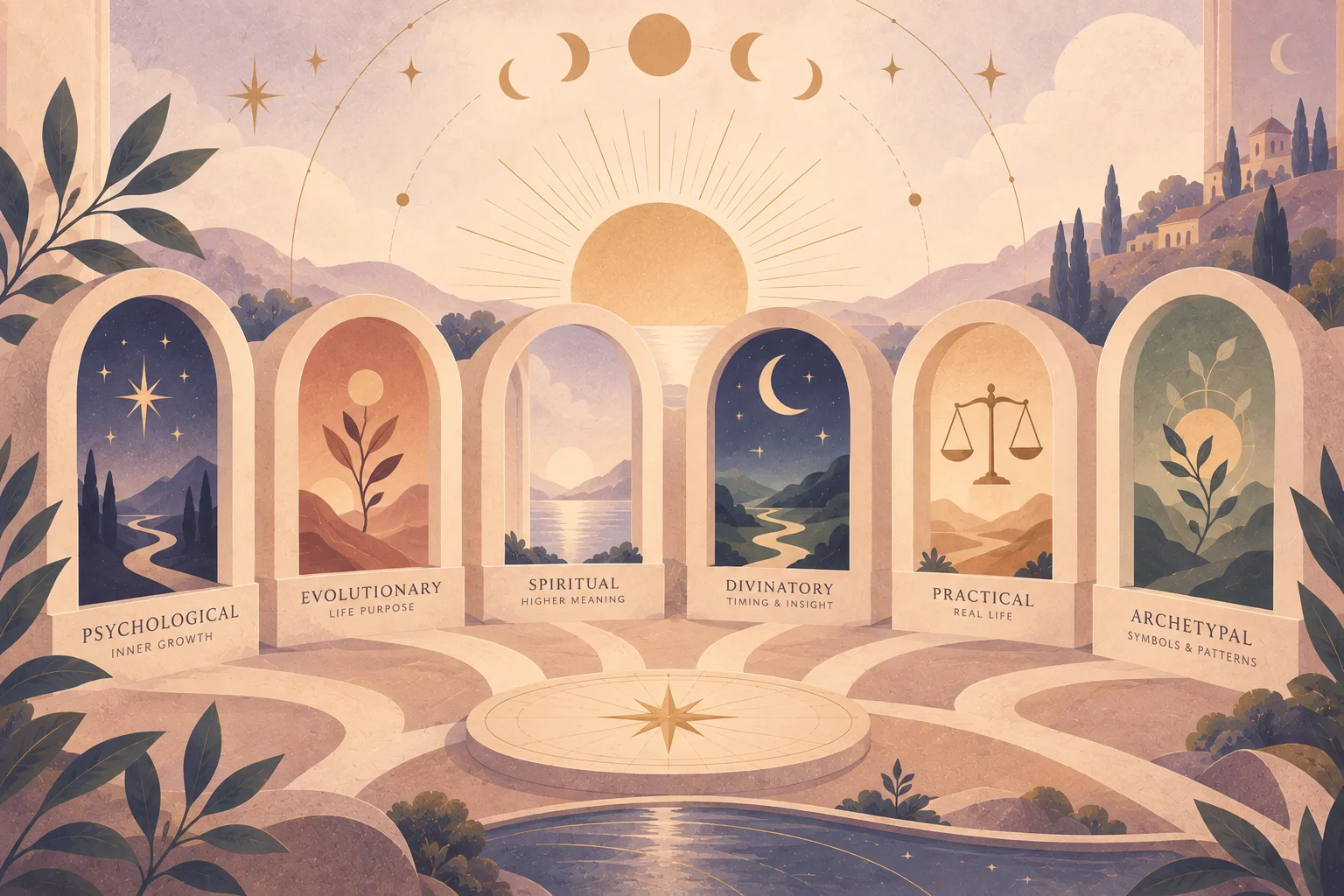
Imagine giving the same birth chart to five astrologers.
One wants to talk about your emotional patterns.
Another starts with Pluto and the lunar nodes.
A third sees the chart as a landscape of archetypes.
A fourth is interested in spiritual meaning.
The fifth wants to know exactly what question you asked and precisely when you asked it.
Nobody has necessarily wandered into the wrong consultation.
They may simply have different approaches to astrology.
This distinction matters because the kind of astrologer you choose can shape the entire experience of a reading.
You can book two astrologers who both describe themselves as Western astrologers, both use birth charts and both know the same planetary symbolism – and nevertheless find yourself having two remarkably different conversations.
One may feel almost like reflective counselling with a zodiac wheel on the table.
The other may be considerably more interested in what Saturn is actually trying to tell us before lunch.
Understanding an astrologer’s approach can therefore be just as useful as knowing which tradition or techniques they use.
What does an astrological approach mean?
On Good Astrologers, we use approach to describe the broad interpretive perspective an astrologer brings to their work.
It is different from a tradition, such as Western astrology or Jyotish.
It is different from a branch, such as natal, horary or electional astrology.
And it is different from a technique, such as transits, synastry or solar returns.
An approach is closer to the question:
What does this astrologer believe they are doing when they interpret a chart?
Are they primarily helping you understand psychological patterns?
Exploring a story of personal development?
Working with archetypal symbolism?
Placing the chart within a spiritual framework?
Or treating astrology as a form of divination?
These categories are not rigid schools with membership cards and annual dinners.
Astrologers often combine them.
A practitioner might describe their work as psychological and archetypal, for example, or combine spiritual and evolutionary perspectives.
The categories are useful because they help you understand the character of the consultation before you book it.
Psychological astrology
Psychological astrology uses the birth chart primarily as a way of exploring the inner life.
The emphasis is often on subjects such as:
- personality
- emotional patterns
- relationships
- needs and motivations
- recurring conflicts
- strengths and vulnerabilities
- personal development
Rather than treating a planetary placement as a fixed prediction, a psychological astrologer may explore the different ways that symbolism could be expressed.
Saturn, for example, might be discussed in relation to fear, responsibility, boundaries, authority or the gradual development of confidence.
The conversation becomes less:
“What will Saturn do to me?”
and more:
“How does this Saturn pattern seem to operate in my life?”
Modern psychological astrology developed partly through dialogue with twentieth-century depth psychology, including ideas associated with Carl Jung.
Jung’s concept of archetypes and his interest in symbols proved particularly influential in some strands of modern astrology.
This does not mean a psychological astrologer is a psychotherapist.
Astrology and therapy are different practices, and responsible practitioners should be clear about that boundary.
But the style of consultation may feel reflective and exploratory.
For someone who wants greater self-understanding rather than definite prediction, that can be appealing.
It is the astrological equivalent of being handed a mirror – although, ideally, one with kinder lighting.
Evolutionary astrology
Evolutionary astrology generally approaches the birth chart as a story of development.
Practitioners often explore questions such as:
- What patterns am I carrying forward?
- What am I trying to develop?
- Why do certain experiences seem to repeat?
- Where does growth require leaving familiar territory?
- What gives my life a deeper sense of direction?
Different schools of evolutionary astrology use different methods.
Some place particular emphasis on Pluto and the lunar nodes. Some use the language of karma, past lives or the evolution of the soul. Others interpret these ideas more symbolically or psychologically.
That variation matters.
If spiritual or reincarnational ideas are important to an astrologer’s approach, they should make that clear rather than presenting them as unquestionable facts.
At its best, evolutionary astrology is not simply telling you that something happened because the universe has placed it in your personal development syllabus.
It is asking what you might do with the pattern now.
The myth of Persephone offers a useful image.
Her story is not simply about descent into the underworld. It is also about return – and about being changed by what has been encountered there.
Evolutionary astrologers often work with astrology in a similar spirit: difficult or repeating experiences may be explored not merely as events, but as part of a longer developmental story.
Archetypal astrology
Archetypal astrology treats planets, signs and other chart symbols as expressions of recurring human patterns.
Instead of asking only what a planet “means”, an archetypal astrologer may explore the wider story associated with it.
Mars, for example, can be linked with assertion, conflict, courage, desire and action.
Venus can speak to attraction, pleasure, relating and value.
Saturn may evoke limits, duty, authority and maturity.
These are not usually treated as one-dimensional definitions.
An archetype contains a range of possible expressions.
Mars can be courage or aggression.
Saturn can be oppressive or stabilizing.
Venus can describe harmony, desire, compromise or the complicated art of wanting something without immediately adding it to your basket.
This is one reason archetypal astrology often appeals to people who enjoy symbolism, mythology and psychology.
The chart becomes less like a set of labels and more like a cast of recurring characters.
That does not mean the astrologer assumes mythology causes planetary influence.
Myth is used as a way of thinking about patterns.
The story of Athena, for example, can evoke themes of strategy, intelligence, independence and conflict conducted through thought rather than brute force.
An archetypal astrologer might use a myth like this to open up a planetary theme rather than to declare that you are secretly an ancient Greek goddess because Mercury happens to be well placed.
The point is interpretation, not costume.
Spiritual astrology
Spiritual astrology explicitly connects astrological symbolism with questions of meaning, purpose or spiritual development.
Depending on the practitioner, this might involve ideas such as:
- soul development
- karma
- spiritual purpose
- intuition
- consciousness
- synchronicity
- connection with something larger than the individual self
There is enormous variation here.
For one astrologer, spiritual astrology may simply mean approaching the chart with openness to mystery and symbolic meaning.
For another, it may sit within a specific religious, esoteric or metaphysical belief system.
Those differences are worth understanding before you book.
A practitioner should be able to explain the beliefs or assumptions that shape their work.
They should also leave room for your own beliefs.
You do not need to adopt somebody else’s cosmology simply because you’ve paid for sixty minutes on Zoom.
A spiritually oriented consultation can be thoughtful and meaningful without pretending to possess secret knowledge about your destiny.
In fact, humility is particularly important when astrology touches questions about fate, karma or the soul.
Those are large ideas.
They deserve more care than certainty.
Divinatory astrology
Divinatory astrology treats astrology as a form of divination.
In simple terms, the chart is approached as a symbolic response to a particular situation, question or moment.
This differs from approaches that primarily use astrology as a map of personality or psychological development.
Horary astrology is one of the clearest examples.
In a horary consultation, an astrologer casts a chart for the moment a meaningful question is received and interprets that chart in relation to the question.
You might ask:
- Will this job opportunity develop?
- Is this the right time to move?
- What is happening with this relationship?
- Where is the missing object?
- What should I understand about this situation?
The astrologer then works with the chart according to established horary rules.
Divinatory approaches tend to take the moment of the question seriously.
The chart is not merely used as a conversation starter.
It is treated as symbolically relevant to the matter being asked about.
This can feel quite different from a psychological consultation.
A psychological astrologer may explore what a relationship pattern means to you.
A divinatory astrologer may be more willing to address the concrete question of what appears to be happening.
That does not require theatrical certainty.
A responsible divinatory astrologer should still communicate limits, ambiguity and judgement.
The oracle at Delphi managed perfectly well with ambiguity for centuries. Modern astrologers do not need to compensate by sounding like push notifications from fate.
Can an astrologer use more than one approach?
Yes – and many do.
These categories are not mutually exclusive.
A practitioner might combine:
- psychological and archetypal astrology
- evolutionary and spiritual astrology
- archetypal and divinatory astrology
- psychological astrology with traditional predictive techniques
That is why a profile containing five labels is not necessarily more informative than an astrologer’s own explanation of how they work.
The controlled categories help you compare practitioners.
Their own description gives you the nuance.
This distinction is important on Good Astrologers.
We use structured information to help people discover astrologers, but we do not expect every practitioner to fit neatly into one philosophical box.
Human beings have proved stubbornly resistant to tidy classification for quite some time.
Astrologers are no exception.
Approach, tradition, branch and technique are not the same thing
Astrology has a lot of overlapping vocabulary, which can make choosing a practitioner unnecessarily confusing.
A simple way to separate the concepts is:
| Term | What it describes | Examples |
|---|---|---|
| Tradition | The broader astrological tradition | Western astrology, Jyotish, Hellenistic astrology |
| Branch | The kind of astrology being practised | Natal, horary, electional, mundane |
| Technique | A specific method used in interpretation | Transits, synastry, solar returns |
| Approach | The interpretive perspective brought to the work | Psychological, evolutionary, archetypal, spiritual, divinatory |
| Life question | What you want help exploring | Relationships, career, purpose, timing |
One astrologer might therefore practise Western astrology, specialize in natal astrology, use transits and synastry, work from a psychological and archetypal approach, and frequently help clients with relationships and personal growth.
Those labels describe different dimensions of the same practice.
This matters because searching only for “a birth chart astrologer” tells you relatively little about what the consultation will actually feel like.
Which approach to astrology is right for me?
Start with the kind of conversation you want.
If you’re primarily interested in understanding your emotional patterns, relationships or inner life, a psychological astrologer may appeal.
If you’re interested in growth, repeating patterns, purpose or karmic themes, you may be drawn to an evolutionary approach.
If symbolism, myth and recurring human patterns fascinate you, archetypal astrology may be a natural fit.
If you want astrology to engage directly with spirituality, meaning or questions of the soul, look for a practitioner who clearly describes a spiritual approach.
And if you have a specific question and want an astrologer who works explicitly with astrology as divination, a divinatory astrologer may be more appropriate.
But do not choose from the label alone.
Read how the astrologer describes their work.
Look at their training and experience.
Notice whether their language makes you feel informed and curious – or merely impressed by how many abstract nouns can be fitted into one paragraph.
A good description should help you understand what will actually happen when you speak to them.
How to compare astrologers with different approaches
Once you know the broad approaches, the next step is not to find the “best” philosophy.
It is to find an astrologer whose way of working suits you.
When reading a practitioner profile, look for evidence that they can explain their approach in ordinary language.
You should be able to understand:
- what they tend to explore in a consultation
- which traditions and techniques they use
- how directive or exploratory their readings are
- whether spiritual or metaphysical beliefs form part of their work
- how they handle prediction and uncertainty
- which kinds of questions they are most experienced in discussing
Labels can help you narrow the field, but clarity matters more.
An astrologer describing themselves as “evolutionary” should still be able to tell you what that means when the two of you are actually sitting in a consultation.
The same applies to psychological, archetypal, spiritual or divinatory work.
Our guide to what defines a good astrologer explains the broader standards we look for, including transparency, boundaries, realistic claims and clear communication.
If you’re still getting your bearings, different types of astrology explained separates traditions, branches and techniques in more detail.
And if you’re close to booking, our guide to how to choose the right astrologer will help you compare individual practitioners.
The approach is part of the relationship
Choosing an astrologer is not simply a technical decision.
You are choosing somebody with whom you may discuss relationships, fears, ambitions, family, money, identity or a period of your life that currently makes very little sense.
How that person understands astrology will influence how they understand your question.
A psychological astrologer may help you notice a pattern.
An evolutionary astrologer may place that pattern within a longer developmental story.
An archetypal astrologer may help you see the symbolic drama underneath it.
A spiritual astrologer may explore its relationship to meaning or purpose.
A divinatory astrologer may ask what the chart says about the situation itself.
None of these approaches has to be the correct one for everybody.
The useful question is simpler:
Which way of working helps you think more clearly about the life you are actually living?
That is a much better basis for choosing an astrologer than collecting terminology as though Mercury were awarding loyalty points.
Frequently asked questions
What are the main approaches to astrology?
Good Astrologers currently uses five broad approaches to describe how practitioners may interpret astrology: psychological, evolutionary, archetypal, spiritual and divinatory.
They are not mutually exclusive, and many astrologers combine more than one.
What is psychological astrology?
Psychological astrology focuses strongly on personality, emotions, relationships, inner conflicts and personal development.
It usually treats the chart as a symbolic way of exploring patterns rather than as a fixed description of personality or destiny.
What is evolutionary astrology?
Evolutionary astrology views the chart through themes of development and growth.
Depending on the school and practitioner, it may explore Pluto, the lunar nodes, repeating patterns, purpose, karma, past lives or ideas about the evolution of the soul.
What is archetypal astrology?
Archetypal astrology interprets planets and other astrological symbols through recurring patterns of human experience.
It often draws on mythology, symbolism and depth psychology to explore the different ways an archetype might appear in someone’s life.
What is spiritual astrology?
Spiritual astrology connects astrological interpretation with questions of meaning, consciousness, purpose or spiritual development.
Because practitioners may hold very different spiritual beliefs, it is worth checking how an individual astrologer describes their own approach.
What is divinatory astrology?
Divinatory astrology treats an astrological chart as symbolically meaningful in relation to a particular question or moment.
Horary astrology is a prominent example, where a chart is cast for the time a meaningful question is received.
You can read more in our introduction to horary astrology.
Can an astrologer be both psychological and evolutionary?
Yes.
Approaches describe different perspectives rather than exclusive professional categories.
An astrologer may combine psychological and evolutionary ideas, archetypal and spiritual approaches, or another combination that reflects how they have trained and developed their work.
How do I know which astrological approach is right for me?
Think first about what you want from the consultation.
Then read how individual astrologers describe their work rather than choosing entirely from a label.
The right practitioner should be able to explain their approach clearly enough that you understand the kind of conversation you are booking.