London Astrologer
London, UK
- Western astrology
- 20+ years’ experience
- Readings: Online and in person

Astrology techniques
Synastry compares two birth charts to explore the dynamics between two people. Astrologers use it to look at attraction, communication, emotional needs, tension, compatibility and the ways two people may affect one another.
There is a particular stage in almost every relationship when somebody starts wondering what on earth is going on.
Sometimes this happens after three dates.
Sometimes after twenty-three years of marriage.
Sometimes it happens halfway through a perfectly ordinary Tuesday when your partner loads the dishwasher in a way that suddenly feels like a profound moral failing.
Relationships have a remarkable ability to show us parts of ourselves that are difficult to see alone.
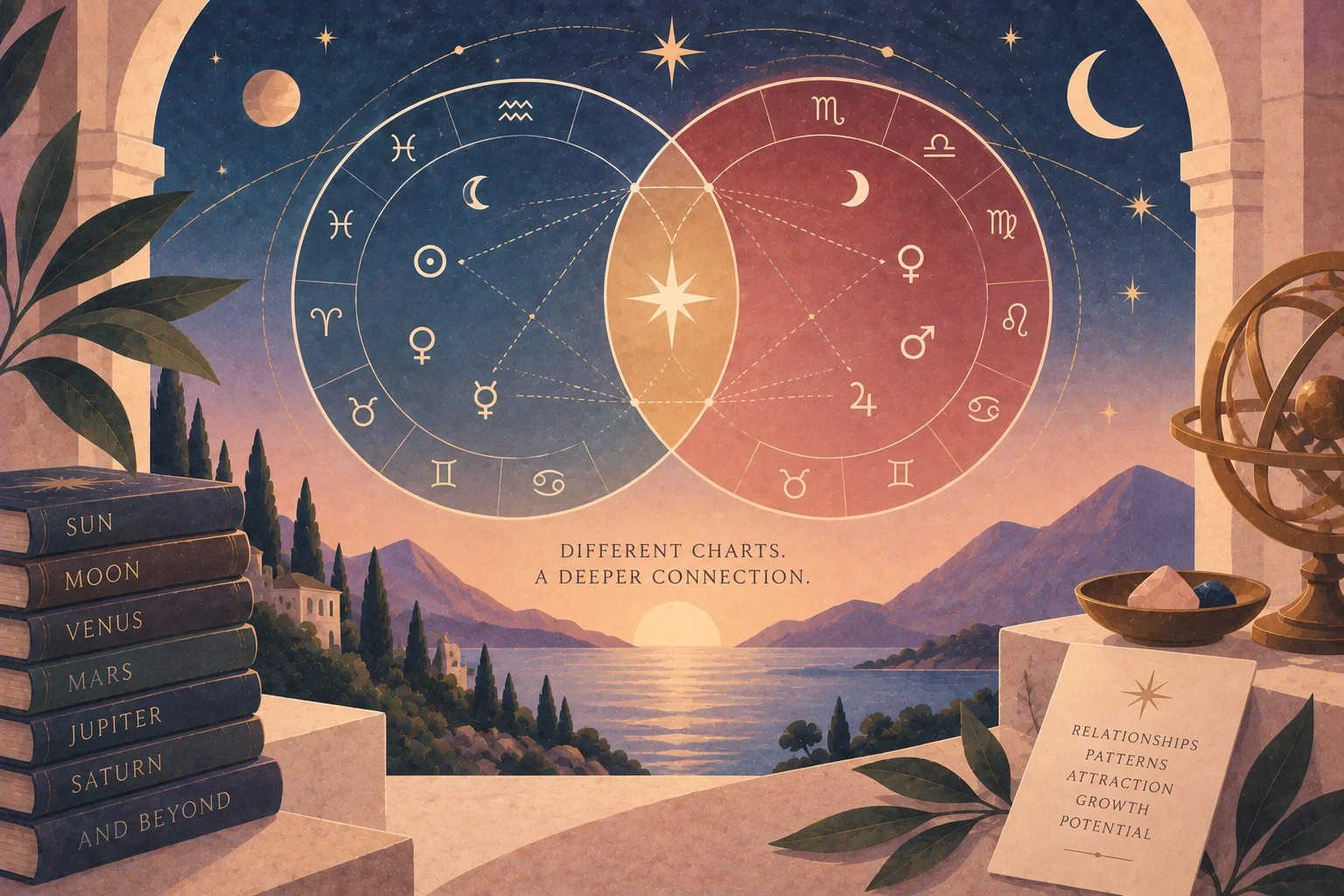
Synastry is one of the techniques astrologers use to explore that territory.
It compares the birth charts of two people and examines the connections between them.
The aim is not simply to decide whether two people are “compatible”.
Human relationships are considerably more complicated than a celestial thumbs-up or thumbs-down.
Instead, synastry can be used to ask more interesting questions.
Why do these two people feel immediately comfortable together?
Why does one person feel energized while the other feels overwhelmed?
Why is communication effortless in one area and astonishingly difficult in another?
Why does somebody you’ve known for three weeks feel strangely familiar?
And why can the person you love most also possess an apparently supernatural ability to press precisely the wrong button?
Synastry is an astrological technique that compares two natal charts.
Each person’s birth chart is calculated separately using their date, place and – where available – time of birth.
The astrologer then examines how the planets and other important points in one person’s chart relate to those in the other person’s chart.
They may look at:
The purpose is to explore the relationship between two individual astrological patterns.
Your birth chart remains your birth chart.
Their birth chart remains theirs.
Synastry looks at what happens when those two symbolic maps meet.
Synastry is one of the most widely used techniques within relationship astrology, but the two terms are not exactly interchangeable.
Relationship astrology is the broader area of astrological practice concerned with relationships.
An astrologer working with relationships might use:
Synastry specifically means comparing two natal charts with one another.
So if you are looking for an astrologer to explore a relationship, you may want someone who works with relationships and love and explicitly uses synastry.
A synastry chart is usually created by placing the planetary positions from two birth charts together so that the astrologer can compare them.
Often one person’s chart is shown in an inner wheel and the other person’s planets in an outer wheel.
The astrologer then studies the angular relationships – known as aspects – formed between the planets in the two charts.
For example:
Each contact brings together two planetary symbols.
The astrologer’s job is to interpret how those symbols may interact within the relationship.
It is not simply a question of counting “good” and “bad” aspects.
That would make relationship astrology wonderfully efficient.
Unfortunately, humans have declined to organize themselves so neatly.
Different astrologers prioritize different factors, but certain themes appear frequently.
The Sun and Moon may be considered when exploring identity, emotional needs and the basic sense of being understood.
Mercury often relates to communication.
Venus can describe affection, attraction, values and how someone gives and receives pleasure.
Mars may be associated with desire, initiative, conflict and the way energy moves between two people.
Jupiter can sometimes suggest encouragement, expansion or shared enthusiasm.
Saturn may point towards commitment, responsibility, boundaries or areas that require work.
Uranus, Neptune and Pluto can add other layers involving change, idealization, intensity and transformation.
But no single planet tells the whole story.
A skilled astrologer reads the pattern rather than hunting for one magic aspect.
The Sun is associated with identity, vitality and the way someone expresses their central sense of self.
When another person’s planets strongly contact your Sun, astrologers may explore how that person affects your confidence, purpose or sense of being recognized.
A harmonious contact might be interpreted as supportive or affirming.
A more challenging contact could highlight differences in priorities or self-expression.
But challenge is not automatically negative.
Sometimes the people who challenge us are precisely the ones who help us become more conscious of who we are.
That may be inconvenient.
Growth often is.
The Moon is especially important in many synastry readings because astrologers associate it with emotional needs, instinctive responses, habits and security.
Moon contacts may help describe why one person feels comforting to another.
They may also show places where emotional styles differ.
One person may need reassurance through conversation.
Another may need space.
One may want immediate emotional engagement.
The other may need three hours, a cup of tea and a small private inquiry into whether feelings can perhaps be postponed until Thursday.
Neither style is inherently wrong.
But understanding the difference can be useful.
Strong Moon contacts can be particularly noticeable in close relationships because they touch the parts of us that are least polished.
Venus is commonly associated with affection, attraction, pleasure, aesthetics and values.
In synastry, Venus contacts can help astrologers explore:
A Venus connection can feel easy and pleasant.
But Venus alone does not create a relationship.
Two people can find each other tremendously attractive and still discover that they cannot agree on where to live, whether they want children or whose turn it is to buy toilet roll.
Compatibility requires more than chemistry.
Mars introduces energy.
It can relate to desire, pursuit, assertion, sexuality, anger and conflict.
Strong Mars contacts sometimes appear in relationships with obvious physical chemistry.
They can also describe relationships that feel competitive, stimulating or occasionally exhausting.
A Mars aspect is not inherently sexual.
Context matters.
Mars between two colleagues might show a highly productive working relationship.
Between siblings, it could describe competitiveness.
Between romantic partners, it may contribute to attraction – or arguments – or both.
Mars has never been particularly interested in being subtle.
Venus–Mars contacts receive enormous attention in popular relationship astrology because of their association with attraction.
And yes, they can be significant.
But they should not be treated as a cosmic guarantee of irresistible romance.
A Venus–Mars connection may suggest that one person’s way of attracting, valuing or relating interacts strongly with the other’s way of pursuing and expressing desire.
That can feel exciting.
It can also create differences in pace, expectations or expression.
And without emotional understanding, communication and compatible real-world values, even impressive chemistry has limitations.
A relationship cannot survive indefinitely on smouldering eye contact.
Eventually somebody has to organize Christmas.
Mercury contacts can be enormously important because relationships are built partly through communication.
An astrologer may use Mercury synastry to explore:
Easy Mercury contacts may coincide with a feeling that conversation comes naturally.
More challenging contacts may require greater effort to understand what the other person actually means.
This does not make the relationship doomed.
In fact, some difficult Mercury contacts can produce stimulating relationships in which two people continually challenge one another intellectually.
The question is whether the difference creates curiosity or contempt.
That distinction has rather more practical significance than the aspect itself.
Saturn tends to attract dramatic interpretations.
It is sometimes described as the planet of restriction, difficulty or karmic obligation.
That is only part of the picture.
Saturn is also associated with structure, responsibility, boundaries, endurance and commitment.
In synastry, strong Saturn contacts may describe relationships that feel serious or significant.
They may bring loyalty and staying power.
They may also highlight areas where one person feels criticized, limited or burdened.
Saturn asks difficult but useful questions.
What are we responsible for here?
Where do we need boundaries?
What can actually last?
Where have affection and obligation become confused?
Those questions may not be especially romantic.
They are nevertheless quite useful once everybody has finished staring soulfully at Venus.
Jupiter is associated with growth, meaning, generosity and expansion.
Strong Jupiter contacts can sometimes correspond with relationships in which one person encourages the other to think more broadly, take chances or explore new possibilities.
There may be shared humour, optimism or intellectual enthusiasm.
But Jupiter can also amplify.
Occasionally two people encourage one another brilliantly.
Occasionally they encourage one another to book a holiday they cannot afford.
The symbolism is not inherently sensible.
It is expansive.
The outer planets move slowly, so many people born within the same age group share similar placements.
For that reason, astrologers often pay particular attention when Uranus, Neptune or Pluto make close contacts to the other person’s personal planets or angles.
Uranus contacts may be associated with excitement, disruption, freedom or unpredictability.
Neptune contacts can relate to imagination, compassion, idealization, spirituality or blurred boundaries.
Pluto contacts may be interpreted through themes of intensity, power, vulnerability and transformation.
These contacts can feel powerful.
But powerful does not necessarily mean healthy, destined or permanent.
Intensity is not the same thing as intimacy.
That is an important distinction both astrologically and psychologically.
When accurate birth times are available, an astrologer can examine where one person’s planets fall within the houses of the other person’s chart.
These are sometimes called house overlays.
For example, someone else’s Venus might fall into your seventh house.
Their Moon might fall into your fourth.
Their Sun might fall into your tenth.
Astrologers interpret these placements according to the life area represented by the house.
A planet falling into the seventh house may emphasize partnership.
The fourth house may bring attention to home, family or emotional foundations.
The tenth may connect with career, visibility or ambition.
House overlays can help explain where in life another person seems to have the greatest impact.
The seventh house is traditionally associated with partnership and one-to-one relationships.
For that reason, planets falling into another person’s seventh house often attract attention in synastry.
They may contribute to the sense that someone naturally occupies the role of partner, collaborator or significant other.
But seventh-house contacts do not automatically mean marriage.
Nor does the absence of seventh-house overlays mean two people cannot have an important relationship.
Real relationships are reflected through the whole chart.
The seventh house is one piece of a much larger picture.
The fifth house is often associated with romance, pleasure, creativity and play.
Strong overlays here may contribute to attraction or the feeling that somebody brings excitement and enjoyment into your life.
The eighth house is associated with intimacy, vulnerability, shared resources and deeper psychological entanglement.
Planets falling there can sometimes produce relationships that feel particularly intense or exposing.
This is one reason astrologers should avoid reducing house overlays to simplistic formulas.
“Your Venus is in my eighth house, therefore we are soulmates” may make excellent social-media content.
It is considerably less useful as relationship analysis.
The Ascendant – or rising sign – is one of the chart’s important angles.
When another person’s planets make close aspects to your Ascendant, astrologers may explore how strongly that person affects your immediate sense of self, expression or attraction.
Sun, Moon, Venus or Mars contacts to the Ascendant can sometimes be particularly noticeable.
The Descendant, Midheaven and IC may also be considered.
Because these angles depend heavily on birth time, accurate birth data becomes much more important here.
You can still do useful synastry work without two exact birth times.
The planetary relationships between many planets can usually still be compared.
However, uncertain birth times create limitations.
Without an accurate time, the astrologer may not reliably know:
If only one person’s birth time is known, the astrologer can still work with the information available.
A responsible astrologer should simply be clear about what can and cannot be interpreted confidently.
If this applies to you, our guide to astrology readings without an exact birth time explains the issue in more detail.
No.
Synastry can be used to explore almost any important relationship.
That might include:
The interpretation changes according to the relationship.
A strong Venus–Mars connection between business partners would not automatically be interpreted as romantic attraction.
Context matters.
Quite a lot, ideally.
It can explore compatibility, but compatibility is not a single astrological quantity.
There is no reliable synastry percentage that can tell you that a relationship is 82% compatible and therefore worth continuing.
Relationships contain different kinds of compatibility.
Two people may communicate brilliantly but have very different emotional needs.
They may share values but struggle with conflict.
They may have enormous chemistry and little practical compatibility.
Or they may have several difficult-looking aspects and nevertheless build a remarkably strong relationship because they understand how to work with their differences.
A synastry reading is most useful when it helps reveal the pattern of the relationship rather than trying to grade it.
This question appears frequently online.
The answer is frustratingly unsensational:
there is no universal list of “best” synastry aspects.
Trines and sextiles are generally described as easier or more flowing.
Conjunctions can be powerful but depend greatly on the planets involved.
Squares and oppositions may create tension, but tension can produce attraction, movement and growth as well as conflict.
A chart containing only effortless contacts would not necessarily create a satisfying relationship.
Some friction is often part of what makes two people matter to one another.
The Greek myth of Eros and Psyche is useful here.
Their story is not memorable because everything goes smoothly.
Love exposes, challenges and changes them.
That does not mean suffering is required for love.
It means relationship is often developmental.
Synastry can help describe where that development may occur.
Not automatically.
Squares and oppositions often receive frightening interpretations online.
But challenging aspects can describe differences that require awareness and negotiation.
For example, Mercury square Mercury might suggest different communication styles.
That could produce endless misunderstanding.
Or it could produce two people who learn a great deal from seeing the world differently.
Mars square Saturn might sometimes feel frustrating.
One person’s drive may encounter the other’s caution or limits.
But in another relationship, that same symbolism might help turn impulsive energy into something disciplined and sustainable.
The chart cannot tell you whether people will handle a difference maturely.
That part belongs to the people.
No.
Easy aspects can create comfort and familiarity.
They can help two people feel naturally understood.
But ease alone does not guarantee a healthy relationship.
Occasionally too much ease produces complacency.
Sometimes people share beautiful Venus and Moon contacts while avoiding an obvious disagreement about what they actually want from life.
Astrology cannot rescue a relationship from reality.
Nor should it try.
There is no agreed astrological signature that proves two people are soulmates.
Some astrologers use spiritual or karmic frameworks and may interpret certain contacts as symbolizing unusually meaningful connections.
Others avoid soulmate language entirely.
Both can work with synastry.
If the idea of karmic relationships is meaningful to you, it can be explored symbolically.
But caution is useful.
The belief that a difficult relationship is “fated” can sometimes encourage people to remain in situations that are unhealthy.
No astrological aspect obliges you to stay with somebody.
A relationship can be meaningful and still need to end.
Not reliably.
Synastry can show themes that astrologers associate with attraction, communication, commitment, tension and emotional connection.
It cannot guarantee duration.
Relationships last or end for many reasons that are not reducible to a chart.
People grow.
Circumstances change.
Values diverge.
Some people work through difficulties.
Others do not.
Saturn contacts are sometimes associated with longevity or commitment, but even strong Saturn synastry does not guarantee a lifelong relationship.
The presence of glue is not proof that two things ought to remain stuck together forever.
This distinction is important.
Synastry compares two separate birth charts.
A composite chart creates a new symbolic chart representing the relationship itself, usually by calculating midpoints between corresponding planetary positions in the two natal charts.
Synastry asks:
How do these two people affect one another?
A composite chart asks something closer to:
What is the character of the relationship they create together?
Many relationship astrologers use both.
They are separate techniques and can illuminate different parts of the relationship.
We’ll explore composite charts separately in this Techniques series.
The basic synastry between two natal charts remains the same because the natal charts themselves do not change.
But the people living those charts do.
Timing techniques can also activate parts of a synastry pattern at different stages of a relationship.
An astrologer might therefore consider synastry alongside transits or secondary progressions.
A difficult synastry aspect may barely register for years and then become more prominent during a particular period.
Likewise, an existing supportive pattern may become especially meaningful during a major transition.
The relationship chart may be fixed.
The relationship is not.
A synastry reading usually begins with the two individual birth charts.
This matters because you cannot understand the interaction between two people without understanding something about each person separately.
The astrologer may then compare:
They may examine planetary aspects and house overlays and explain where the charts reinforce or challenge one another.
A thoughtful reading should not turn either person into the villain.
Nor should it declare one person “more evolved” because they happen to have fewer squares.
The best relationship astrology preserves the complexity of both individuals.
No.
One person can consult an astrologer about a relationship.
However, ethical considerations matter when interpreting somebody who is not present.
A responsible astrologer should avoid claiming certainty about another person’s private thoughts, intentions or psychological state.
Synastry can describe the relationship pattern from an astrological perspective.
It should not become a method for mind-reading.
Questions such as:
“Why do we communicate this way?”
are generally more constructive than:
“Tell me exactly what they secretly feel about me.”
The second question asks astrology to provide certainty it cannot responsibly provide.
Potentially.
A synastry reading can sometimes give people useful language for differences they already recognize.
One person may value directness.
The other may experience directness as confrontation.
One may need frequent emotional reassurance.
The other may show love primarily through practical support.
Neither person needs to be wrong for the difference to become difficult.
Seeing the pattern clearly can create more room for choice.
That is where relationship astrology can become psychologically interesting.
Not:
“The chart made us argue.”
But:
“This seems to be a recurring dynamic between us. What do we want to do with it?”
It shouldn’t.
An astrologer can help you explore patterns within the relationship.
They can reflect themes.
They can ask questions.
They can help identify where tensions or strengths appear astrologically.
But major relationship decisions belong to you.
If a relationship involves abuse, coercion, violence or fear, astrological compatibility is not the relevant measure. Appropriate practical and professional support matters far more.
A difficult synastry chart is not evidence that a relationship is unsafe.
And an apparently harmonious one is not evidence that it is safe.
Real-world behaviour always matters more than astrological symbolism.
Good questions tend to be exploratory rather than deterministic.
You might ask:
These questions leave room for both astrology and human agency.
Look for someone who explicitly works with relationship astrology and lists Synastry among their techniques.
Read how they describe their approach.
Some astrologers work psychologically and emphasize communication, patterns and self-understanding.
Others are more predictive, spiritual or traditional.
None of these approaches is automatically better.
The right choice depends on what you want from the consultation.
If you’re looking for someone to explore a relationship, you can browse astrologers for relationships and love.
It is also worth asking whether the astrologer:
Understanding the technique is useful.
Understanding the astrologer’s approach is just as important.
Our guide to astrology traditions, branches, approaches and techniques explains those distinctions.
There is no established scientific evidence demonstrating that synastry can reliably measure compatibility or predict relationship outcomes.
Astrology is better understood as a symbolic and interpretive practice than as a scientifically validated relationship test.
That distinction matters.
A synastry reading may give people an interesting framework for thinking about a relationship.
It should not be presented as objective proof that two people belong together – or apart.
Synastry is the comparison of two birth charts. Astrologers examine aspects, planetary contacts and sometimes house overlays to explore the dynamics between two people.
No. Synastry can be used for romantic partners, friends, family members, colleagues, business partners and other important relationships.
There is no single most important planet. The Sun, Moon, Mercury, Venus, Mars and Saturn are commonly emphasized, while contacts involving the Ascendant and other angles can also be significant when accurate birth times are available.
No astrological combination can objectively prove that someone is your soulmate. Some astrologers use spiritual or karmic interpretations, but these remain interpretive rather than factual.
There is no universally best aspect. Venus, Moon, Sun and Mars contacts often receive attention in romantic synastry, but the overall pattern of both charts matters much more than a single aspect.
Not necessarily. Squares can describe tension or differences that require effort, but they can also create stimulation, attraction and development. How people handle the dynamic matters enormously.
Exact birth times provide more information because they allow reliable interpretation of houses, the Ascendant and other angles. Useful planetary synastry can still be possible without exact times.
Compatibility is the broader question of how well two people may function together. Synastry is one astrological technique used to explore the relationship dynamics that may contribute to compatibility.
Synastry compares two individual natal charts. A composite chart creates a separate symbolic chart representing the relationship itself.
Perhaps the most useful thing about synastry is that it resists the fantasy that relationships should be effortless if they are “right”.
Two people arrive with different histories, needs, fears, desires and ways of understanding the world.
Of course there will be friction.
The interesting question is what kind.
In mythology, Hermes moved between worlds.
There is something appropriate about that image for relationships.
To understand another person, we continually cross the distance between their world and ours.
Sometimes we make the journey easily.
Sometimes we get hopelessly lost halfway.
Synastry offers one symbolic map of that territory.
It cannot tell you whether you should love somebody.
It cannot guarantee that they will stay.
And it cannot turn incompatibility into compatibility through particularly enthusiastic interpretation.
What it can do is give you another language for asking:
What happens between us?
And perhaps, more importantly:
What do we want to do with what happens between us?
Find a good astrologer
Compare professional astrologers by their experience, approach, traditions and consultation options.
London, UK
Toronto, Canada

Sydney, Australia

Seattle, United States
San Francisco, United States
New York, USA