
You know your Sun sign.
Perhaps you know your Moon and Rising signs too. You may even have reached the stage where you can casually mention your Venus placement over dinner without feeling that an explanation is required.
Then you look at a Vedic astrology chart.
Suddenly your signs may have changed, the chart looks completely different and somebody is talking about nakshatras, dashas and something called Rahu.
It can feel as though the universe has quietly changed the paperwork.
It hasn’t.
Western astrology and Vedic astrology are different astrological traditions. They use some of the same astronomical information – including the positions of the Sun, Moon and planets – but organize and interpret that information through different historical, technical and philosophical frameworks.
That distinction matters if you’re choosing an astrologer.
A Western astrologer and a practitioner of Jyotish may begin with exactly the same date, time and place of birth and yet emphasize different parts of the chart, use different timing methods and frame the consultation in rather different ways.
Neither approach needs to be declared the winner.
This is less like choosing between a correct map and an incorrect one, and more like discovering that two maps can organize the same landscape according to different priorities.
Hermes might have appreciated the confusion. As the mythological traveller between worlds, he was rather good at crossing boundaries and translating between different systems of meaning. The rest of us may need a little more explanation.
So let’s start with the biggest difference.
What is the difference between Western astrology and Vedic astrology?
Western astrology and Vedic astrology – more accurately known as Jyotish – developed within different cultural and intellectual traditions.
Western astrology has roots in ancient Mesopotamian, Hellenistic and later European astrology. Over many centuries it developed through medieval, Renaissance and modern forms, eventually producing the extraordinarily varied Western astrology practised today.
Jyotish developed within the Indian astrological tradition and has its own long history, technical literature, philosophical context and methods of interpretation.
There are connections and historical exchanges between astrological cultures, so neither tradition developed in complete isolation.
But they should not be treated as interchangeable systems.
The most immediately visible difference is usually the zodiac itself.
Tropical and sidereal zodiacs
Most contemporary Western astrology uses the tropical zodiac.
The tropical zodiac is anchored to the seasonal cycle, with the beginning of Aries defined by the March equinox.
Jyotish usually uses a sidereal zodiac, which relates zodiacal positions to a stellar reference framework.
Because these systems establish the zodiac differently, a planet can appear in one sign in a typical Western chart and another sign in a Jyotish chart.
This is why somebody who has spent thirty-five years confidently identifying as a Leo can open a Vedic astrology calculator and discover that the administrative department of the cosmos has apparently reassigned them.
Nothing about the sky at your birth has changed.
The two traditions are measuring zodiacal longitude using different reference systems.
This difference is sometimes presented online as a contest over which zodiac is the “real” one.
That isn’t especially helpful.
The tropical zodiac makes sense within the framework of tropical Western astrology. The sidereal zodiac makes sense within the framework of Jyotish and other sidereal traditions.
The more useful question is:
How does each tradition use its zodiac to interpret the chart?
Will my Sun sign change in Vedic astrology?
It might.
Because the tropical and sidereal zodiacs are offset from one another, many planetary placements move back approximately one sign when converted from a typical tropical Western chart to a sidereal Jyotish chart.
So someone with a tropical Sun in early Libra, for example, may have a sidereal Sun in Virgo.
The same can happen with the Moon, Ascendant and other planets.
This often produces the slightly disorienting experience of being told that the sign you’ve been casually explaining yourself with for years has apparently packed a small bag and moved next door.
But it doesn’t mean that one chart has exposed the “real you” and the other has been wrong all along.
Each placement exists within a wider interpretive system.
A Virgo Sun interpreted through Jyotish is not simply a Western Virgo description substituted for a Western Libra one.
The tradition surrounding the placement matters.
Do Western and Vedic birth charts look different?
Very.
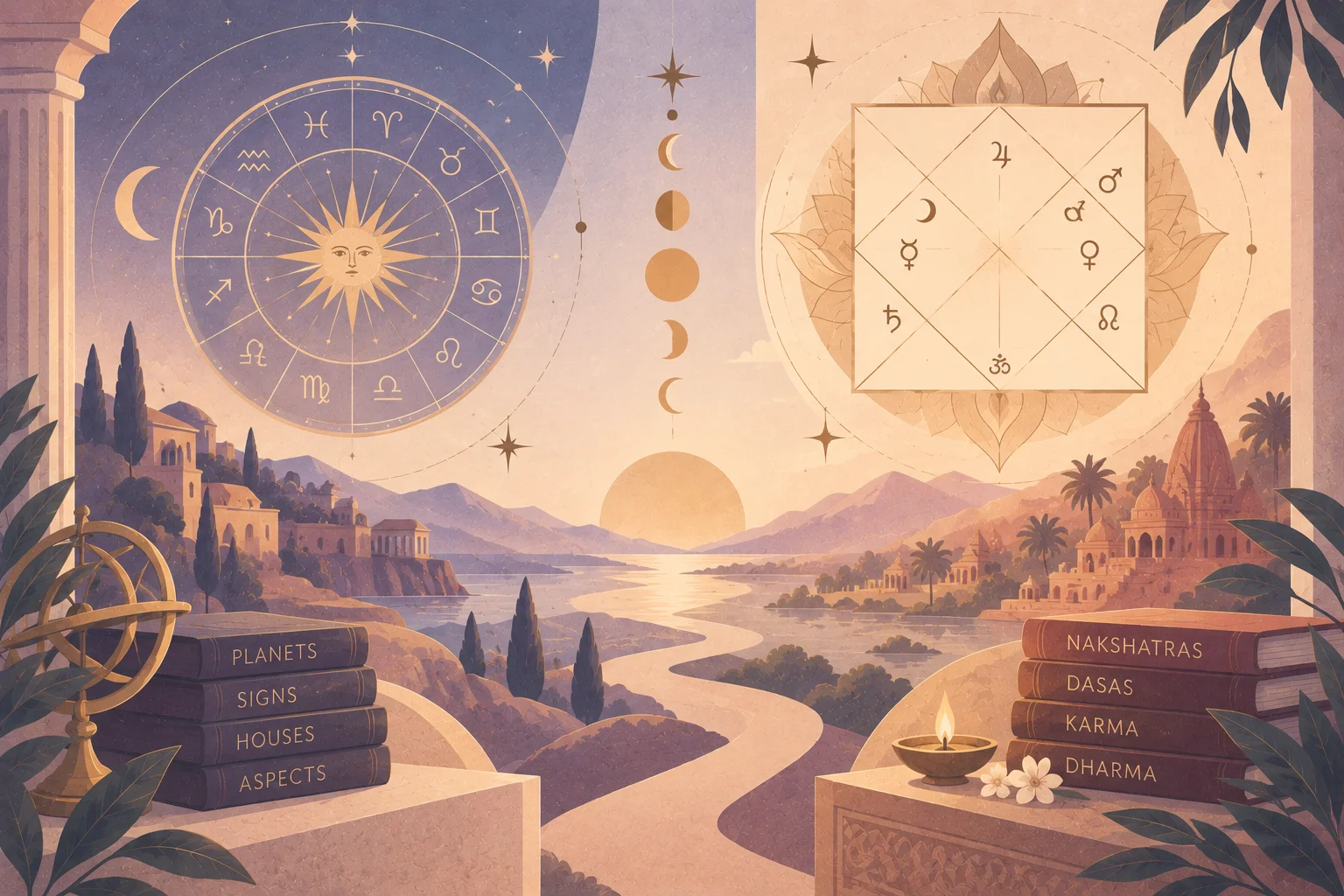
A modern Western birth chart is often shown as a circular wheel divided into twelve signs and twelve houses.
Jyotish charts are commonly displayed using square or diamond-shaped formats, with the exact layout varying between different regions of India.
Visually, they can seem unrelated.
Underneath, however, both are ways of representing planetary positions and their relationships to different areas of the chart.
The layout is not the astrology itself.
It is the way the information is organized.
Do they use the same planets?
There is considerable overlap, but not complete agreement about what receives emphasis.
Both traditions work extensively with:
- the Sun
- the Moon
- Mercury
- Venus
- Mars
- Jupiter
- Saturn
Modern Western astrology also commonly uses Uranus, Neptune and Pluto.
Classical Jyotish traditionally works with the seven visible planets alongside the lunar nodes, Rahu and Ketu, which hold major interpretive importance within the tradition.
Rahu and Ketu are not physical planets. Astronomically, they are the points where the Moon’s orbit crosses the ecliptic.
Astrologically, Jyotish treats them as highly significant.
Western astrologers may also interpret the lunar nodes, although they are not given exactly the same meaning or role.
What are nakshatras?
One of the distinctive features of Jyotish is its use of nakshatras.
These are lunar mansions – divisions of the zodiac associated particularly with the Moon’s position.
A commonly used system contains 27 nakshatras, each with its own symbolism and traditional associations.
They add another layer of interpretation beyond the twelve zodiac signs.
This means that two people whose Moon occupies the same zodiac sign may nevertheless have Moons in different nakshatras and therefore receive rather different interpretations.
For someone coming from Western astrology, this can feel like opening a familiar wardrobe and discovering an entire room behind it.
The twelve signs were not the end of the story after all.
What are dashas?
Jyotish is particularly well known for its sophisticated systems of planetary periods, called dashas.
A dasha system divides life into periods associated with particular planets.
There are several systems, but Vimshottari dasha is among the most widely used.
An astrologer may examine which planetary period you are currently experiencing and then consider how that planet is placed and functioning within your natal chart.
This can give Jyotish consultations a strong emphasis on timing and unfolding periods of life.
Western astrologers also work extensively with timing, but often use different methods – such as transits, secondary progressions, solar returns, solar arc directions or annual profections.
So both traditions may ask:
Why does this particular period of life feel important?
They simply have different tools for exploring the answer.
How do the two traditions interpret houses?
Both Western astrology and Jyotish use twelve houses to describe different areas of life.
These can include subjects such as:
- identity
- money and resources
- communication
- home and family
- relationships
- work
- career
- spirituality
But the rules used to interpret houses, their rulers and the planets occupying them can differ substantially.
Jyotish commonly uses whole-sign houses, although practice varies.
Western astrologers use several house systems, including whole sign, Placidus and others.
This is another reason simply comparing one isolated placement between the two systems can be misleading.
The placement sits within an entire network of relationships.
Ariadne’s thread is a useful image here. When you’re faced with two charts, dozens of unfamiliar terms and several competing internet explanations, the way through the labyrinth is not to compare every symbol individually.
Follow the logic of the tradition as a whole.
Do Western and Vedic astrology use aspects differently?
Yes.
In much of Western astrology, aspects are geometric relationships between planets – such as conjunctions, oppositions, squares, trines and sextiles.
These relationships are usually interpreted according to the angular distance between the planets.
Jyotish has its own systems of planetary aspects, commonly called drishti.
Different planets may be understood to cast particular aspects according to rules that are not identical to the standard Western aspect system.
Some schools of Jyotish also use sign-based aspects.
The underlying principle is familiar – planets are understood partly through their relationships with one another – but the technical grammar is different.
Is Western astrology more psychological?
Sometimes.
Modern Western astrology has been strongly influenced by twentieth-century psychology and by ideas associated with figures such as Carl Jung.
Many contemporary Western astrologers therefore use the birth chart to explore:
- personality
- emotional patterns
- relationships
- inner conflicts
- personal development
- meaning and identity
But Western astrology is much broader than psychological astrology.
Traditional, Hellenistic, medieval and divinatory approaches can be quite different.
Likewise, it would be misleading to describe Jyotish simply as “predictive astrology”.
Many practitioners use it to explore personality, relationships, vocation, spiritual questions and meaning as well as timing.
The difference is not that one system understands the inner life while the other predicts external events.
Both traditions contain considerable diversity.
The more useful distinction is that they developed different interpretive languages and technical priorities.
Western astrology vs Vedic astrology: key differences
Here’s the comparison in simpler form.
| Western astrology | Jyotish (Vedic astrology) | |
|---|---|---|
| Zodiac | Usually tropical | Usually sidereal |
| Chart style | Commonly circular | Commonly square or diamond-shaped |
| Outer planets | Uranus, Neptune and Pluto widely used in modern practice | Traditionally centred on the seven visible planets plus Rahu and Ketu |
| Lunar mansions | Not usually central | Nakshatras are an important part of the tradition |
| Timing | Often transits, progressions, solar returns, profections and other techniques | Often dashas alongside transits and other timing techniques |
| Aspects | Usually based on angular relationships between planets | Uses its own systems of planetary and, in some schools, sign aspects |
| Modern psychological influence | Common in contemporary Western practice | Not the defining framework, although practitioners may explore psychological themes |
| Tradition | Encompasses modern, traditional, Hellenistic and other Western schools | Part of the Indian astrological tradition |
These are broad distinctions rather than rules applying to every astrologer.
Two Western astrologers may work very differently from one another. So may two Jyotish practitioners.
Which brings us to the question people usually want answered.
Which is better: Western or Vedic astrology?
There is no useful universal answer.
People sometimes discover Jyotish after years of Western astrology and feel that it describes something they had previously struggled to articulate.
Other people encounter a Vedic chart and find that the language or style of consultation does not resonate with them nearly as much as Western astrology.
That tells us something important about choosing an astrologer.
A system can be intellectually interesting without necessarily being the right way for you to explore your life.
You may be drawn to Western astrology if you want a consultation that emphasizes psychological patterns, symbolism or a familiar tropical birth chart.
You may be drawn to Jyotish if you’re interested in its sidereal framework, nakshatras, dashas or the wider Indian astrological tradition.
Or you may simply discover an excellent astrologer whose way of working makes the choice for you.
That is often more useful than spending three evenings trying to establish which zodiac has won the internet.
Can you use both Western and Vedic astrology?
You can study or consult practitioners from both traditions.
What is less useful is casually mixing individual techniques without understanding the system they came from.
Astrological techniques carry assumptions with them.
A placement, house ruler or timing method usually makes sense because of the interpretive framework around it.
So if your Western chart says one thing and a Jyotish reading seems to say another, you do not necessarily need to reconcile them into one enormous master chart.
Allow each tradition to speak its own language first.
You can then decide whether either – or both – gives you a useful perspective.
How should you choose between a Western and Vedic astrologer?
Start with the consultation rather than the label.
Ask yourself what you actually want help exploring.
Are you interested in understanding patterns in your personality and relationships? Are you facing a career decision? Are you curious about timing? Do you want to explore a spiritual question? Or are you simply trying to understand your birth chart for the first time?
Then look at how the astrologer works.
Useful things to check include:
- which astrological tradition they use
- their training and experience
- the techniques they specialize in
- how they describe their approach to readings
- whether they explain what a consultation can and cannot offer
- whether their style feels appropriate for the question you want to explore
Our guide to what defines a good astrologer explains the standards we think matter regardless of astrological tradition.
You can also read our guide to astrology readings if you’re not yet sure what kind of consultation you’re looking for.
Does one system predict the future better?
Claims that one tradition is simply “more accurate” than another deserve caution.
Astrology is practised through interpretation. Different astrologers use different techniques, levels of experience and ways of communicating uncertainty.
Jyotish has highly developed timing methods, including dashas, and forecasting is an important part of many practitioners’ work.
Western astrology also has substantial forecasting traditions, using techniques such as transits, progressions, solar returns, profections and directions.
Neither gives an astrologer a licence to claim certainty about exactly what will happen to you.
A responsible astrologer should be able to discuss possibilities, patterns and periods of emphasis without presenting the future as though it has already been entered into a celestial Google Calendar.
The most important difference may be the astrologer
It is tempting to make the choice entirely about systems.
Tropical or sidereal. Western or Vedic. Transits or dashas.
But eventually another person is going to interpret the chart with you.
Their judgement, knowledge, communication style and professional boundaries matter.
An astrologer who understands their tradition deeply, explains their reasoning clearly and leaves you with greater perspective and autonomy may be far more useful than someone who happens to practise the system you initially thought you wanted.
So explore the traditions.
Notice which ideas interest you.
But when it is time to book a reading, choose the astrologer, not simply the label on the astrology.
Frequently asked questions
Is Vedic astrology the same as sidereal astrology?
Not exactly.
Jyotish usually uses a sidereal zodiac, but sidereal astrology is a broader category. Other astrologers and traditions can also use sidereal zodiacs.
Vedic astrology – more accurately called Jyotish – is a complete astrological tradition with its own interpretive principles and techniques. Its use of a sidereal zodiac is only one part of that system.
Why is my zodiac sign different in Vedic astrology?
Most Western astrology uses the tropical zodiac, while Jyotish usually uses a sidereal zodiac.
Because the two systems calculate zodiacal positions from different reference points, your Sun, Moon, Ascendant or other planets may fall in different signs.
This does not mean your birth information has changed. The two traditions are organizing the same astronomical positions through different zodiacal frameworks.
Is Vedic astrology more accurate than Western astrology?
There is no reliable basis for saying that one system is universally more accurate than the other.
They use different frameworks and techniques, and the quality of a consultation also depends heavily on the astrologer’s knowledge, judgement and communication.
Be cautious of anyone claiming that one tradition can provide guaranteed predictions or absolute certainty.
Can I have both a Western and Vedic astrology reading?
Yes.
You can consult astrologers from both traditions and explore what each approach offers.
It is usually more useful to understand each system on its own terms rather than trying to combine every placement or prediction into a single chart.
What is the main difference between Western and Vedic astrology?
One of the clearest technical differences is the zodiac.
Most Western astrologers use the tropical zodiac, while Jyotish usually uses a sidereal zodiac.
But the differences go much further than that. The traditions also have different interpretive rules, timing techniques and areas of emphasis.
Should I choose a Western or Vedic astrologer?
Choose according to the kind of consultation you want and the individual astrologer’s way of working.
Look at their tradition, training, experience, techniques, approach and how clearly they explain what a reading can offer.
If you’re still deciding, read different types of astrology explained and our guide to how to choose the right astrologer.