Some astrological timing techniques require complicated charts, specialist software and calculations that look as though somebody has accidentally wandered into an advanced mathematics seminar.
Annual profections are refreshingly different.
The basic principle is almost suspiciously simple.
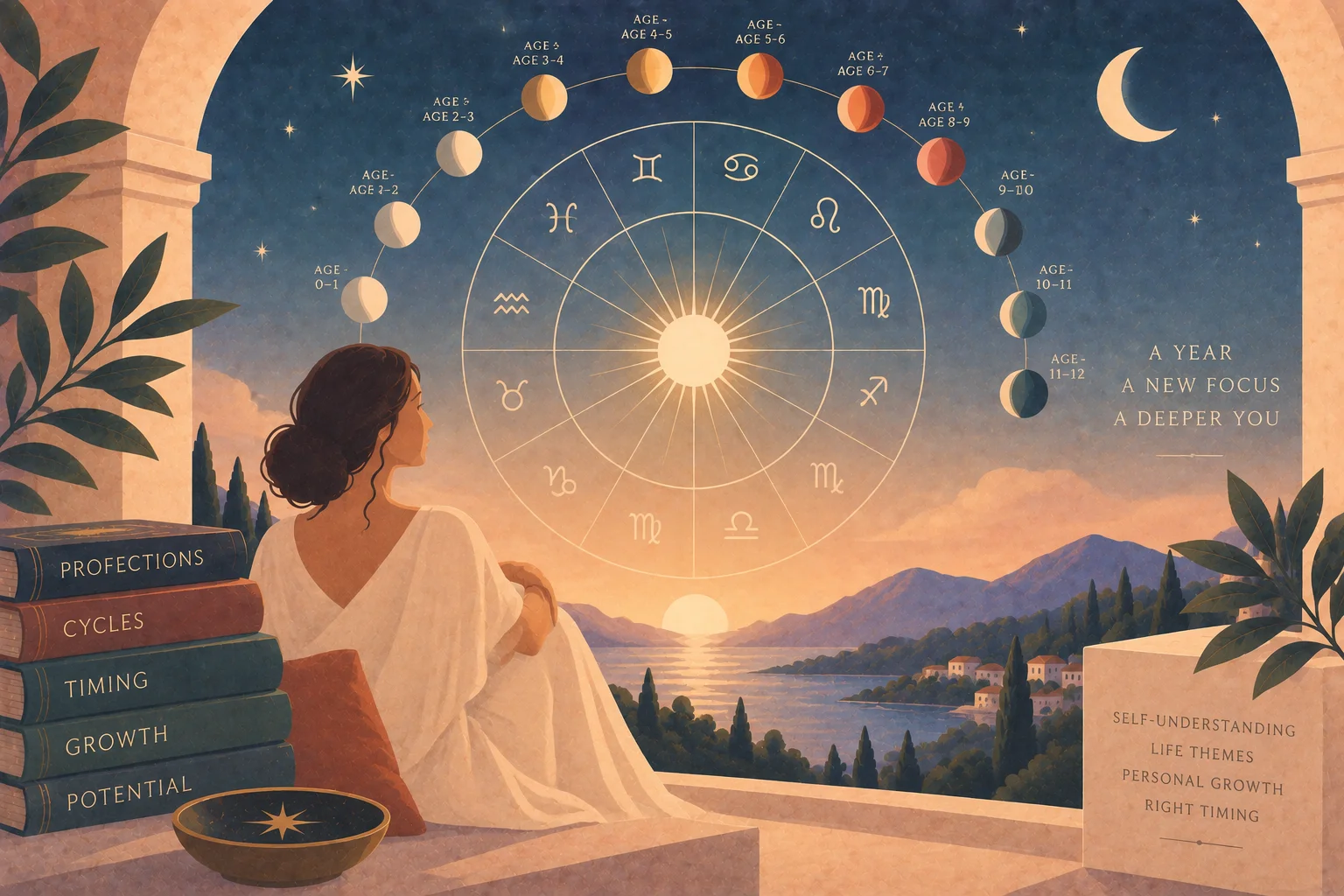
Each year of your life activates one of the twelve houses of your birth chart.
At birth, the first house is activated.
At age one, the second.
At age two, the third.
And so on until age eleven activates the twelfth house.
At twelve, the cycle begins again with the first.
This repeating twelve-year sequence is called annual profection.
Astrologers then examine the activated house, the zodiac sign associated with it and the planet ruling that sign to explore which areas of life may become particularly important during the year.
Simple calculation.
Potentially rich interpretation.
What are annual profections?
Annual profections are a traditional astrological timing technique used to identify an area of the natal chart that becomes especially significant during a particular year of life.
The method is strongly associated with Hellenistic astrology and has become increasingly popular again among astrologers interested in traditional techniques.
In the commonly used whole-sign method, each birthday advances the profection by one house.
The activated house is often called the profected house.
The planet ruling the zodiac sign of that house becomes especially important and is commonly called the:
- lord of the year
- time lord
- ruler of the profection
The astrologer then interprets that planet and the activated house in the context of the natal chart and other timing techniques.
How do annual profections work?
The cycle begins with the first house during the first year of life.
It then moves forward one house with each birthday.
The pattern is:
| Age |
Profected house |
| 0 |
1st house |
| 1 |
2nd house |
| 2 |
3rd house |
| 3 |
4th house |
| 4 |
5th house |
| 5 |
6th house |
| 6 |
7th house |
| 7 |
8th house |
| 8 |
9th house |
| 9 |
10th house |
| 10 |
11th house |
| 11 |
12th house |
| 12 |
1st house |
Then the cycle repeats.
So:
- age 24 is another first-house year
- age 30 is a seventh-house year
- age 36 is another first-house year
- age 42 is another seventh-house year
A quick way to work it out is to divide your age by twelve and use the remainder.
But most astrology software can calculate it instantly.
The arithmetic is not really the interesting part.
The interpretation is.
When does an annual profection year begin?
Annual profections usually run from birthday to birthday.
Your profected house changes when you reach your next age.
If you are 34, for example, you remain in the profection associated with age 34 until your 35th birthday.
This means the profection year does not begin on 1 January.
Your personal astrological year follows your birthday.
That also makes annual profections a natural technique to use alongside a solar return chart.
Both organize astrological timing around the annual solar cycle, although they work in completely different ways.
What does the profected house mean?
The profected house identifies an area of life that astrologers may treat as especially important during the year.
For example:
First-house profection
The first house is associated with:
- identity
- body
- personal direction
- appearance
- self-definition
A first-house year may bring greater focus to the individual themselves.
Second-house profection
The second house is associated with:
- money
- possessions
- income
- resources
- personal values
Financial questions may become more prominent.
Third-house profection
The third house can relate to:
- communication
- siblings
- local environment
- short journeys
- learning
Fourth-house profection
The fourth house may emphasize:
- home
- family
- roots
- parents
- private life
- property
Fifth-house profection
The fifth house is traditionally connected with:
- creativity
- pleasure
- romance
- children
- self-expression
Sixth-house profection
The sixth house may draw attention to:
- work
- routines
- health
- service
- obligations
Seventh-house profection
The seventh house emphasizes one-to-one relationships, including:
- romantic partnerships
- marriage
- business partnerships
- contracts
- significant others
Eighth-house profection
The eighth house may involve:
- shared resources
- debts
- inheritance
- financial entanglements
- vulnerability
Ninth-house profection
The ninth house can emphasize:
- travel
- higher education
- philosophy
- religion
- publishing
- broader perspectives
Tenth-house profection
The tenth house is especially associated with:
- career
- public life
- reputation
- authority
- ambition
Eleventh-house profection
The eleventh house may highlight:
- friends
- groups
- networks
- alliances
- hopes and longer-term goals
Twelfth-house profection
The twelfth house is traditionally associated with themes such as:
- withdrawal
- isolation
- hidden matters
- limitations
- private struggles
Modern astrologers may also explore rest, retreat or unconscious patterns here, depending on their approach.
None of these houses guarantees a particular event.
The profection simply tells the astrologer where to look more closely.
What is the lord of the year?
The lord of the year is usually the planet that rules the zodiac sign of the profected house.
Suppose somebody has Aries rising.
Using whole-sign houses:
- Aries is the first house
- Taurus is the second
- Gemini is the third
- Cancer is the fourth
If that person enters a second-house profection year, Taurus becomes activated.
Venus rules Taurus.
Venus therefore becomes the lord of the year.
The astrologer then pays particular attention to Venus.
They may examine:
- where Venus sits in the natal chart
- which house Venus rules natally
- Venus’s condition
- natal aspects to Venus
- transits involving Venus
- what Venus is doing during important moments of the year
This is where the apparently simple profection technique becomes much richer.
What does the lord of the year tell you?
The lord of the year acts somewhat like a leading character in the astrological story of that year.
Its natal placement can connect the activated house with another part of life.
Imagine someone enters a tenth-house profection year.
The tenth house emphasizes career and public life.
If the lord of the year sits natally in the seventh house, professional developments might become connected with:
- clients
- partners
- contracts
- collaboration
- important one-to-one relationships
Another person could have the same profected house but a completely different lord of the year.
Their year would not necessarily look the same.
This is why annual profections are more sophisticated than simply saying:
“You are 33, therefore this will be a tenth-house year.”
That is only the beginning.
What planets can become lord of the year?
In traditional rulership, the seven classical planets rule the zodiac signs:
- Mars rules Aries and Scorpio
- Venus rules Taurus and Libra
- Mercury rules Gemini and Virgo
- Moon rules Cancer
- Sun rules Leo
- Jupiter rules Sagittarius and Pisces
- Saturn rules Capricorn and Aquarius
Traditional profection practice therefore generally uses these classical rulers.
This means Uranus, Neptune and Pluto do not normally become the lord of the year in the traditional method.
Modern astrologers may still consider those planets elsewhere in the chart.
But if they are using profections traditionally, the time-lord rulership comes from the classical system.
Do annual profections use whole-sign houses?
The most common contemporary revival of annual profections uses whole-sign houses.
In this system, the entire rising sign becomes the first house, the next sign the second, and so on.
This fits naturally with the traditional technique.
However, astrology contains multiple schools and historical variations.
If your astrologer uses profections differently, ask them to explain their method.
Knowing the calculation method helps you understand what you are actually being shown.
What is a first-house profection year?
First-house profection years happen at ages:
and so on.
The first house brings attention back to the individual.
Astrologers may explore themes involving:
- identity
- body
- independence
- direction
- self-presentation
- beginning a new personal cycle
Because the Ascendant sign itself is activated, its ruling planet becomes the lord of the year.
These periods can sometimes feel especially personal.
The spotlight turns back towards:
Who am I becoming?
What is a seventh-house profection year?
Seventh-house years occur at ages:
and so on.
The seventh house is associated with important one-to-one relationships.
This can include romantic partnerships, but it is not limited to them.
Themes might involve:
- marriage
- dating
- clients
- business partnerships
- collaboration
- contracts
- significant interpersonal dynamics
A seventh-house profection does not mean you will definitely marry.
It simply means that seventh-house topics become activated within the technique.
The lord of the year and other timing factors provide more context.
What is a tenth-house profection year?
Tenth-house profection years occur at ages:
and so on.
The tenth house is strongly associated with career, reputation, achievement and public life.
People often become particularly interested in this profection when thinking about professional development.
Possible themes could include:
- changing jobs
- taking on responsibility
- becoming more visible
- reconsidering professional goals
- gaining recognition
- starting a business
- questioning what success actually means
Not every tenth-house year produces a dramatic career event.
Sometimes the development is more internal.
You may simply become much more conscious of where your working life is heading.
Are some profection houses better than others?
Not really.
Certain houses have traditionally been considered more fortunate or more difficult.
But turning the twelve-house cycle into a league table is rarely useful.
A second-house year could bring financial opportunity.
It could also bring financial responsibility.
A fifth-house year might coincide with romance and pleasure.
It might also involve the demands of parenting or a serious creative project.
A twelfth-house year may sound alarming in traditional texts.
But it can also coincide with a period of retreat, privacy or necessary withdrawal.
The house tells you the area of emphasis.
It does not tell you whether your annual performance review from the universe will be five stars.
Annual profections and transits
Profections are often used alongside transits.
The profection identifies an activated house and planet.
Transits can then help astrologers understand when those themes may become especially prominent.
Suppose Jupiter is the lord of the year.
An astrologer may pay extra attention to major transits involving Jupiter during that year.
Or perhaps Mars crosses the profected house.
That transit may receive additional significance because the house is already activated.
This is one reason profections are sometimes described as a time-lord technique.
They help astrologers decide which planets deserve particular attention during a period.
Annual profections and solar returns
Annual profections and solar returns are frequently used together.
The profection identifies:
- the activated house
- the lord of the year
The solar return provides a full chart for the Sun’s annual return.
An astrologer might then ask:
- Where is the lord of the year in the solar return?
- Is it strongly placed?
- Does the solar return emphasize the profected house?
- Are the same themes repeating?
Repeated symbolism across techniques can become particularly interesting.
The techniques remain separate.
But they can reinforce one another.
Annual profections and secondary progressions
Annual profections move in a regular twelve-year cycle.
Secondary progressions use symbolic planetary movement based on the day-for-a-year principle.
Progressions often describe slower developmental processes.
Profections create a clearer annual rhythm.
An astrologer might therefore use progressions to understand a longer phase of life and profections to identify which natal topics become especially emphasized within a particular year.
Are annual profections predictive?
Yes, they have historically been used as a predictive timing technique.
But “predictive” does not have to mean fortune-telling.
A responsible astrologer can use annual profections to identify themes that deserve attention without pretending that one activated house guarantees one concrete event.
For example, a fourth-house year may emphasize home and family.
That could manifest as:
- moving house
- renovating
- caring for a parent
- changing family dynamics
- spending more time at home
- researching ancestry
- reconsidering where you belong
The symbolism defines a field of experience.
It does not dictate one outcome.
Can annual profections predict marriage?
A seventh-house year can bring partnership themes into greater focus.
The lord of the year, natal chart and other timing techniques may strengthen that emphasis.
But a seventh-house profection cannot guarantee marriage.
At age 30, millions of people enter a seventh-house profection year.
They do not all get married.
Some begin relationships.
Some leave them.
Some sign business contracts.
Some spend the year learning how not to lose themselves in other people’s expectations.
The house describes a category of life.
Context determines the story.
Can annual profections predict career changes?
A tenth-house year may place greater emphasis on career or public direction.
But career developments can also arise through other houses.
A second-house year might emphasize income.
A sixth-house year may highlight working conditions.
A ninth-house year could coincide with retraining or study.
An eleventh-house year might bring professional networks into focus.
Astrology rarely respects our desire to file every experience neatly under one heading.
Can annual profections show difficult years?
They may identify years in which traditionally difficult houses or planets become more prominent.
But “difficult” needs context.
Suppose Saturn becomes lord of the year.
That might correspond symbolically with:
- increased responsibility
- delays
- boundaries
- discipline
- consolidation
- serious commitments
Those experiences can feel demanding.
They can also be productive.
Likewise, Jupiter becoming lord of the year may sound automatically wonderful.
But Jupiter can also amplify excess, overconfidence or unrealistic expectations.
Planets are not annual customer-satisfaction ratings.
What happens during an annual profections reading?
An astrologer may begin with your natal chart and calculate the profection for your current age.
They will identify:
- the activated house
- the sign associated with it
- the lord of the year
- the natal placement of that planet
- houses ruled by that planet
- important natal aspects
- relevant transits
They may also compare the profection with:
- solar returns
- transits
- secondary progressions
- other traditional timing techniques
The aim is to build a coherent picture of the year rather than producing a list of disconnected predictions.
What questions can annual profections help explore?
Useful questions might include:
- Which area of life deserves more attention this year?
- What does my lord of the year represent in my natal chart?
- Why does a particular theme seem unusually prominent?
- Which transits are especially important this year?
- How does my solar return reinforce the profection?
- What responsibilities or opportunities may become more relevant?
- How does this year fit within the repeating twelve-year cycle?
You might also compare your current year with the last time the same house was activated twelve years earlier.
Sometimes interesting thematic echoes appear.
Not identical events.
Themes.
Life does enjoy a rhyme more than an exact repeat.
Why do profections repeat every twelve years?
There are twelve houses.
Annual profections advance one house each year.
After twelve years, the cycle returns to the first house.
This means ages separated by twelve years share the same profected house.
For example:
- 21, 33 and 45 are all tenth-house years
- 24, 36 and 48 are all first-house years
- 30, 42 and 54 are all seventh-house years
This can make retrospective reflection particularly interesting.
What happened twelve years ago?
Was the same area of life emphasized?
Has your relationship with that theme changed?
Astrology cannot prove that the repetition is causal.
But as a symbolic framework, the twelve-year rhythm can offer useful questions.
Where do annual profections come from?
Annual profections have roots in ancient astrology and are particularly associated with the Hellenistic astrological tradition.
Versions of profection techniques were used by astrologers in the ancient Mediterranean world and continued through later astrological traditions.
Their modern revival has accompanied renewed interest in historical astrological texts and techniques.
That historical context matters.
Annual profections are not simply a new social-media astrology trend, even though the technique has become much more visible online in recent years.
Are annual profections part of Hellenistic astrology?
Yes.
Annual profections are strongly associated with Hellenistic astrology and are commonly taught as one of its timing techniques.
They are also used by astrologers working within broader traditional or contemporary practices.
This is a good example of why traditions and techniques are different taxonomy layers.
Hellenistic astrology is a tradition.
Annual profections are a technique.
An astrologer might work primarily within Hellenistic astrology and use profections extensively.
Another astrologer might work broadly within Western astrology while borrowing profections as one of several timing methods.
Our guide to astrology traditions, branches, approaches and techniques explains these distinctions in more detail.
Do you need an exact birth time for annual profections?
Usually, yes – especially if you want to use the technique reliably.
Annual profections depend on the rising sign and house structure.
If the birth time is unknown, the Ascendant may also be unknown.
That makes it difficult to determine which sign forms the first house and therefore which houses are activated.
Some astrologers may still explore alternative approaches when the birth time is uncertain.
But for the standard method, a reasonably accurate birth time is important.
If yours is uncertain, see our guide to astrology readings without an exact birth time.
Can I calculate my annual profection myself?
Yes.
Once you know your rising sign and age, the basic calculation is simple.
Start with the first house at age zero.
Move forward one house for each year.
Or use the repeating twelve-year pattern.
What becomes more complex is identifying and interpreting the lord of the year.
That requires understanding:
- sign rulership
- natal house placement
- planetary condition
- aspects
- house rulership
- relevant transits
Calculating the profected house takes seconds.
Interpreting it well takes considerably longer.
How do I find an astrologer who uses annual profections?
Look for a practitioner who explicitly lists Annual profections among their techniques.
Because the method is strongly associated with historical practice, astrologers working within Hellenistic astrology or other traditional approaches may be especially likely to use it.
But don’t assume.
Check the practitioner’s profile or ask before booking.
You may also want to ask:
- Do you use whole-sign houses for profections?
- How do you determine the lord of the year?
- Do you combine profections with solar returns?
- Do you use transits alongside the time lord?
- How predictive is your approach?
These questions tell you much more than simply knowing that somebody “does profections”.
Are annual profections scientifically proven?
There is no established scientific evidence showing that annual profections reliably predict events or demonstrate a causal connection between activated astrological houses and human experience.
Annual profections belong to astrology’s symbolic and historical interpretive traditions.
Some people find the repeating cycle useful for reflecting on how priorities change over time.
That should not be confused with scientific validation.
Frequently asked questions
What are annual profections?
Annual profections are an astrological timing technique in which one house of the natal chart becomes activated for each year of life. The activated house and its planetary ruler are used to explore themes that may receive particular emphasis during that year.
How do I find my profection year?
Start with the first house at age zero and move forward one house for every year of age. The cycle repeats every twelve years.
What is the lord of the year?
The lord of the year is generally the traditional ruler of the zodiac sign associated with the profected house. Astrologers give that planet additional importance during the year.
What house is activated at age 30?
Age 30 is a seventh-house profection year.
What house is activated at age 33?
Age 33 is a tenth-house profection year.
What house is activated at age 36?
Age 36 begins another first-house profection year.
Do annual profections start on your birthday?
Yes. Annual profections are generally calculated from one birthday to the next rather than by calendar year.
Are annual profections Hellenistic?
They are strongly associated with Hellenistic astrology and form part of the revival of ancient and traditional astrological timing techniques.
Are annual profections predictive?
They have historically been used predictively, but they are better understood as identifying activated themes and time lords rather than guaranteeing specific events.
A twelve-year rhythm
Annual profections are appealing partly because of their simplicity.
One house.
One year.
Then another.
Around and around the chart.
Yet the repetition does not mean repetition of the same life.
Your seventh-house year at 18 is not your seventh-house year at 42.
You have changed.
Your relationships have changed.
Your circumstances have changed.
The same symbolic territory is being visited by a different version of you.
There is something almost mythic about that circular movement.
The ancient Greeks imagined Kairos not simply as chronological time, but as the meaningful or opportune moment.
Annual profections offer a similar invitation.
Not:
What must happen this year?
But:
What part of life is asking for my attention now?
Sometimes a very old technique can produce a surprisingly contemporary question.